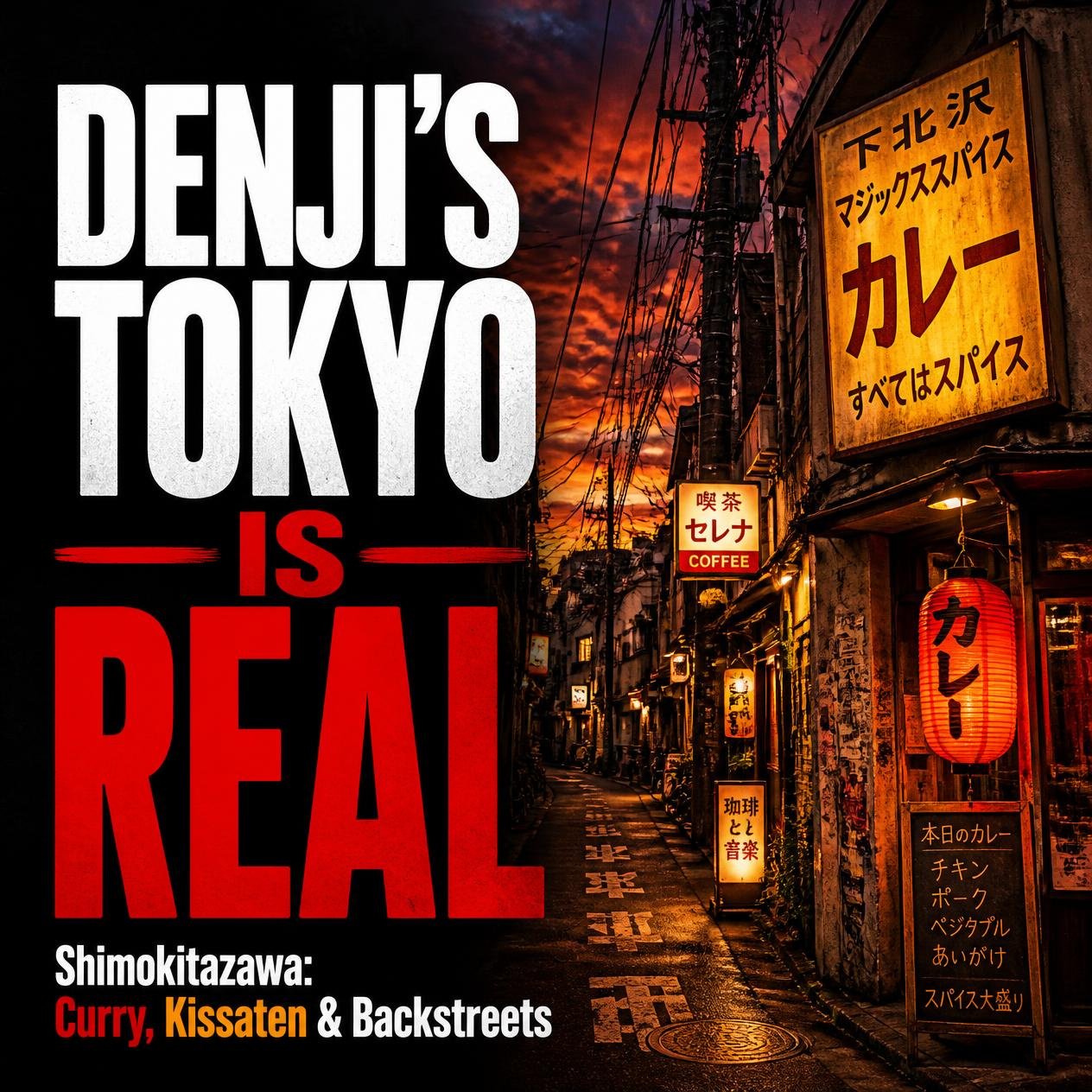
DENJI’S TOKYO IS REAL — AND IT’S IN SHIMOKITAZAWA: A Half-Day Anime Pilgrimage Through Curry, Kissaten & Gritty Backstreets
There is a Tokyo that never appears on a bucket list. No neon towers, no Shibuya scramble, no conveyor-belt sushi. It is a Tokyo of narrow side streets where telephone poles still tangle overhead, where a record shop and a curry restaurant share the same crumbling staircase, where a kissaten café has held the same dark-wood counter since 1980. If you have ever watched Chainsaw Man and felt the grim, lived-in weight of Denji’s urban world — or felt the eerie uncanny-valley domesticity of the low-rise residential blocks that SSSS.Gridman’s kaiju trample — this is the neighborhood you were sensing without knowing its name.
Shimokitazawa (下北沢), a 15-minute train ride from Shinjuku or Shibuya in western Tokyo, is one of the very few urban neighborhoods left in the capital that still feels genuinely scruffy, independent, and human-scaled. Locals call it “Shimokita.” Among Japanese people in their twenties and thirties it is famous, above almost everything else, for curry — the neighborhood hosts over 30 independent curry restaurants and runs its own annual Curry Festival every October. Almost none of this exists in English-language travel media, where “Tokyo food” still defaults to sushi, ramen, or conveyor-belt novelty.
This guide is for international anime fans who want more than a selfie at a pilgrimage marker. You will get the atmospheric backstreets that echo the visual DNA of two landmark anime series, three of the neighborhood’s best and most characteristically distinct curry restaurants, and one legendary kissaten for a post-meal slow-down — all linked into a half-day itinerary you can complete on foot from a single station exit.
- Quick Summary
- 1. Honda Theatre Alley & the Suzunari Side Streets — Chainsaw Man’s Urban DNA
- 2. Senrogai & the Old Railroad Zone — Bocchi the Rock’s Indie Heartland
- 3. Nasu Oyaji Curry — The Oldest Curry Shop in Shimokita
- 4. Magic Spice Tokyo Shimokitazawa — The Soup Curry Originator
- 5. Rojiura Curry SAMURAI Shimokitazawa — Hokkaido Vegetables in a Tokyo Backstreet
- 6. Café Trois Chambres — Shimokitazawa’s Most Beloved Kissaten
- Travel Tips for a Shimokitazawa Half-Day
- Suggested Half-Day Itinerary
- Conclusion
- Sources
Quick Summary
| Stop | Type | Why It’s On This List | Walk from Station |
|---|---|---|---|
| Honda Theatre Alley & Suzunari Side Streets | Anime Pilgrimage Street | Chainsaw Man urban backstreet aesthetic; SSSS.Gridman low-rise block atmosphere | 3–5 min |
| Senrogai & the Old Railroad Zone | Anime Pilgrimage Street | Redeveloped but atmospheric; Bocchi the Rock & broader western-Tokyo indie aesthetics | 2 min |
| Nasu Oyaji Curry | Keema/Homestyle Curry | Oldest curry shop in Shimokita; open since 1990 | 4 min |
| Magic Spice Tokyo Shimokitazawa | Soup Curry | Originator of the Hokkaido-inflected soup curry style; bilingual menu | 4–6 min |
| Rojiura Curry SAMURAI Shimokitazawa | Soup Curry | Hokkaido chain’s first Tokyo outpost; vegetable-forward; English support | 5–7 min |
| Café Trois Chambres | Vintage Kissaten | Open since 1980; Shimokitazawa’s most beloved old-school kissa | 5 min |
1. Honda Theatre Alley & the Suzunari Side Streets — Chainsaw Man’s Urban DNA
Why This Spot Is Worth Visiting
No plaque marks this as a Chainsaw Man location, and that is precisely the point. The anime’s visual world — its telephone-pole-tangled lanes, uneven paving, low-rent residential blocks, and the particular texture of western-Tokyo streets that have not been gentrified into uniformity — does not belong to one confirmed filming spot. It belongs to a type of neighborhood, and Shimokitazawa is one of the last places in central Tokyo where you can still walk inside that type.
The TV anime Chainsaw Man, adapted from Tatsuki Fujimoto’s hit manga, follows Denji — a young devil hunter scraping through a world that is visually dirty, morally compromised, and unmistakably Tokyo in its bones. The confirmed pilgrimage spots for the Reze Arc movie sit around Jinbocho and Ochanomizu, where the Showa-era architecture, narrow slopes, and quiet side streets match the tone of the story. But the broader urban backdrop of Chainsaw Man Season 1 is rooted in the western-Tokyo residential zone, with multiple pilgrimage sites mapped around Nerima — the same low-rise, utility-wire-and-concrete aesthetic that you can experience on foot in Shimokitazawa’s backstreets without crowds or queues.
SSSS.Gridman, the 2018 Studio Trigger anime set inside a computer-simulated city of Tsutsujidai, is obsessively faithful to the look of the Japanese low-rise residential block — the kind of generic, slightly anonymous, deeply lived-in suburban streetscape that Shimokitazawa’s west side still preserves. Gridman’s city exists because someone built it from memory: ordinary streets, utility poles, blank concrete walls, summer skies above two-storey buildings. Walk the lane behind Honda Theatre or the tight residential blocks west of Suzunari, and you will feel it.
Access
From Shimokitazawa Station’s South Exit (南口), walk straight south along the covered shopping street for about two minutes. Honda Theatre (本多劇場) and its surrounding alley complex are on your left. The Suzunari theatre and its immediate back-lanes are a further 2-minute walk west. The whole compact zone is easily explored on foot within 20–30 minutes.
Best Time to Visit, and Times/Days to Avoid
The backstreets are best experienced on a weekday morning between 10am and noon, when shopkeepers are setting up and foot traffic is thin — the light is good for photography, and the street-level calm feels genuinely atmospheric. Weekend afternoons, especially from 2–5pm on Saturdays, bring the heaviest crowds to the main shopping street, which can dilute the atmosphere. The backstreets themselves stay relatively quiet even then, but the surrounding area feels busier. Avoid national holidays if possible.
Practical Notes
- These are public streets and residential lanes — no admission, no opening hours
- Be respectful of residents: keep noise levels low and do not photograph into private homes
- The streets are uneven and narrow in places; comfortable shoes recommended
- No dedicated parking nearby — come by train
How to Combine This Spot With Others
Start here first thing in the morning when the streets are quiet and the light is at its best. The pilgrimage walk naturally leads you south and west toward the Daizawa area, where both Nasu Oyaji Curry and Café Trois Chambres are located — you can arrive at either for their opening time after exploring on foot.
2. Senrogai & the Old Railroad Zone — Bocchi the Rock’s Indie Heartland
Why This Spot Is Worth Visiting
Shimokitazawa’s relationship with anime runs deeper than the Chainsaw Man aesthetic alone. The fall 2022 breakout anime Bocchi the Rock! embedded its entire narrative in Shimokitazawa’s live-house and indie-music district, going to great lengths to recreate specific corners of the neighborhood with remarkable spatial fidelity. The area in front of Shimokitazawa Station — and especially the Senrogai zone developed along the old underground Odakyu railway track — appears repeatedly in the series. For fans of Bocchi, the neighborhood was already a pilgrimage destination before this article was written.
But beyond Bocchi, Senrogai matters because of what it represents physically: the redevelopment of Shimokitazawa’s sunken railway has created a long corridor of small independent shops, record stores, coffee counters, and vintage stalls on what was once an open rail trench. It is the newest part of the neighborhood, and the most photographed, but it sits right beside the oldest parts — making it the perfect place to get your bearings before heading into the tighter streets.
Access
Exit Shimokitazawa Station from the North Exit (北口) or East Exit (東口). The Senrogai zone and old railroad development runs almost immediately along the tracks — you can see it from the station platform. The main pedestrianised stretch is a 2-minute walk at most.
Best Time to Visit, and Times/Days to Avoid
Senrogai is an outdoor pedestrian zone that fills up on weekend afternoons. For atmosphere similar to Bocchi’s quieter, introspective scenes, visit on a weekday around noon when the lunch crowd is beginning to arrive but the space is still navigable. Saturday and Sunday afternoons from 1–4pm are the most crowded, with shoppers and tourists filling the narrow corridor. Evening visits have a distinct mood — fairy lights, music from the live houses — and are worth it if you plan to catch a live music show.
Practical Notes
- Most individual shops in Senrogai open around 11am–noon
- No admission to the outdoor corridor itself
- Live houses in the area (including the legendary Shimokitazawa Shelter) require separate tickets for events — check schedules in advance if you want to combine a pilgrimage with a show
- The Shelter and Honda Theatre are still active live music venues; pick up a flyer map inside for the full Bocchi the Rock! geography
How to Combine This Spot With Others
Senrogai makes a natural starting point for the full half-day loop: browse the corridor, take your Bocchi photos, then head south into the backstreets for the Chainsaw Man / SSSS.Gridman atmosphere walk before circling back east for curry and kissaten.
3. Nasu Oyaji Curry — The Oldest Curry Shop in Shimokita
Why This Spot Is Worth Visiting
Shimokitazawa is widely recognised among Japanese locals as a “Curry District” — a neighbourhood where curry culture has accumulated for decades across more than 30 independent restaurants. But before any of the newer soup-curry specialists or Instagram-friendly spice kitchens arrived, there was Nasu Oyaji.
One of the oldest curry spots in Shimokitazawa, Nasu Oyaji has been serving homemade curry since 1990. Its specialty is a rich, vegetable-based curry with a deep umami flavour, most famously featuring its signature eggplant (nasu) topping — hence the name. The menu is deliberately simple: five types, including chicken, beef, vegetable, mushroom, and special curry. This is the opposite of the customisable soup-curry experience; it is one person’s vision of what curry should taste like, quietly refined over more than three decades. The shop also sells records and hosts occasional live music events, which tells you everything about Shimokitazawa. The restaurant is a 4-minute walk from the station and is open noon to 10pm (last order 9:30pm), though hours can be irregular — check ahead if visiting mid-week.
This is not a restaurant that appears on most tourist itineraries. It is the kind of place Japanese food writers mention in the same breath as neighbourhood memory. That is exactly why it belongs on yours.
Access
From Shimokitazawa Station’s South Exit, walk south along the main shopping street, then turn right (west) into the Daizawa residential zone. The restaurant is inside the Alfa Building at 5-36-8 Daizawa, Setagaya-ku — look for a modest street-level shopfront. About 4 minutes on foot.
Best Time to Visit, and Times/Days to Avoid
Opening time (noon) on weekdays is the best bet for a short or no wait. Weekend lunch hours from 12:30–2pm tend to generate queues — worth arriving just before opening. Nasu Oyaji has irregular closing days, so checking its social media or calling ahead for mid-week visits is advisable. If the curry runs out, the restaurant closes early; arriving late in the evening carries that risk.
Practical Notes
- Hours: Noon–10pm (last order 9:30pm); irregular closures — verify before visiting
- Cash preferred; card acceptance has varied historically — bring yen
- A small, intimate space; no reservations typically taken
- Very limited English menu — point-and-order works fine; the counter staff are used to curious visitors
How to Combine This Spot With Others
Nasu Oyaji is in the Daizawa zone, a 2-minute walk from Café Trois Chambres — this pairing makes perfect sense as a lunch-then-coffee sequence. Alternatively, use it as an early dinner stop between the afternoon backstreet walk and an evening live-music show at Shelter or Honda Theatre.
4. Magic Spice Tokyo Shimokitazawa — The Soup Curry Originator
Why This Spot Is Worth Visiting
Soup curry is now mainstream enough to appear on Tokyo convenience-store shelves. Magic Spice is why. This Sapporo-born restaurant is widely credited as one of the originators of the soup curry format — a genre that is quite unlike either Indian or standard Japanese curry, defined by a deeply spiced, dashi-forward broth served separately from chunky, individually arranged ingredients rather than ladled thickly over rice. The format asks you to dip, sip, and customise in a way that no other curry tradition quite does.
The Shimokitazawa branch — known locally as “Tokyo Goten” — is an experience before you even touch the food. The interior is decorated in deep reds and golds with strong Buddhist-Indian influence; staff have been described as wearing saris. The spice level system has seven tiers, named with cosmological ambition: Awakening, Dream, Hell, Nirvana, Paradise, Sky, and Void. The menu offers a bilingual ordering experience, which makes it unusually accessible for international visitors. Options include chicken, seafood, hamburger steak, and momo (Nepalese gyoza), and the nearly thirty available toppings include maitake mushrooms, Hokkaido coral mushrooms, seasonal vegetables, and tofu. There is even a “kimagure” (capricious) curry that appears only when the owner is present. It is that kind of place.
Current hours: Monday, Thursday, Friday: 11:30am–3pm and 5:30pm–11pm. Saturday, Sunday, and public holidays: 11:30am–11pm. Closed Tuesday and Wednesday. Address: 1F, Golf Building, 1-40-15 Kitazawa, Setagaya-ku. This is approximately a 4–6 minute walk from Shimokitazawa Station. Note that hours have varied slightly across sources and since a recent relocation — always check the restaurant’s official social media before visiting.
You can book a Tokyo food experience through Klook to pair with this itinerary — check for guided food experiences here if you’d rather explore with a local guide.
Access
From Shimokitazawa Station’s North Exit, walk north-east toward Kitazawa — the restaurant is at 1-40-15 Kitazawa, approximately 4–6 minutes on foot. Look for the Golf Building (ゴルフマンション). The distinctive décor makes it instantly recognisable once you’re on the right lane.
Best Time to Visit, and Times/Days to Avoid
Magic Spice has ranked second in a 2024 survey of Shimokitazawa spots popular with foreign tourists — meaning its reputation has spread. Expect waits on weekend lunch service from noon to 2pm. The best window is a weekday lunch, arriving at 11:30am when it opens — you should be seated immediately. Evenings on weekdays are also calm. The restaurant is closed Tuesday and Wednesday.
Practical Notes
- Bilingual (English/Japanese) menu available — good accessibility for non-Japanese speakers
- No-smoking restaurant
- Price range: approximately ¥1,000–¥2,000 per person
- The “Nirvana” spice level is recommended for first-timers who like heat — do not jump straight to Void unless you are genuinely experienced with intense chilli
- If the “kimagure” curry is on the board, order it without asking questions
How to Combine This Spot With Others
Magic Spice sits near the north side of the station zone, making it a natural lunch stop after a morning at Senrogai and the Bocchi the Rock! pilgrimage spots. After eating, walk south through the backstreets toward Nasu Oyaji’s zone and Café Trois Chambres for the afternoon portion of the itinerary. If you are choosing between Magic Spice and Rojiura Curry SAMURAI, the rough decision matrix is: Magic Spice for maximum atmospheric weirdness and the originator’s mystique; SAMURAI for precision, vegetable quality, and reliable English support.
5. Rojiura Curry SAMURAI Shimokitazawa — Hokkaido Vegetables in a Tokyo Backstreet
Why This Spot Is Worth Visiting
Rojiura Curry SAMURAI’s Shimokitazawa branch was the chain’s first Tokyo outpost — a meaningful distinction in a city where every square metre of restaurant space tells a story. The Sapporo-born soup curry operation built its reputation on a single concept: “Eat a Day’s Worth of Vegetables.” Each bowl of its famed golden soup arrives loaded with Hokkaido-sourced produce, prepared without chemical seasonings, flour, or oil. The vegetables are procured from Hokkaido farms with a high reputation for freshness, and the rice comes from the same cold north.
The ordering system here is pleasingly architectural. Choose your curry (chicken with 20 kinds of vegetables, braised pork belly with 12 kinds, hamburger steak, seafood, and more), then your soup base (regular, mild, coconut, or mild coconut), then your spice level on a scale of 0 to 10, then your rice portion size. The result is a bowl that is as much a composition as a meal — vegetables arranged separately in the wide bowl, the soup poured alongside, the protein resting on top. English support is available, and the price range sits at ¥1,000–¥2,000 per person.
Hours (verified as of late 2025 via multiple sources): Lunch 11am–3:30pm (last order 3pm), Dinner 5:30pm–9:30pm daily. Address: 3-31-14 Kitazawa, Setagaya-ku. Approximately a 5–7 minute walk from Shimokitazawa Station. Always verify current hours at the official website (samurai-curry.com) before visiting, as hours have varied between sources.
Access
From Shimokitazawa Station’s South-West Exit or East Exit, walk toward Kitazawa 3-chome. The restaurant is at 3-31-14 Kitazawa — a 5–7 minute walk south-east of the station. Google Maps is reliable for this one.
Best Time to Visit, and Times/Days to Avoid
The restaurant opens daily (no regular closing day), which is a practical advantage in a neighbourhood where many independent spots close mid-week. Weekday lunch service from 11am opening is quietest. Weekend lunch service from noon onward can generate queues — the neighbourhood’s curry reputation means this spot draws a crowd. If you arrive and face a 20-minute wait, use the time to explore the immediate backstreet — there is a small park and several vintage clothing stores within a minute’s walk.
Practical Notes
- Opens daily (no regular closing day, but hours can shift — check samurai-curry.com)
- English menu and English support available
- No smoking inside
- Price range: ¥1,000–¥2,000 per person
- The coconut milk soup base is a good choice for first-timers; it softens the spice while retaining all the depth of flavour
- Spice level 2–3 is a comfortable entry point; the scale goes up to 10 and the restaurant means it
How to Combine This Spot With Others
SAMURAI works best as a dinner stop — arrive at 5:30pm after spending the afternoon doing the backstreet walk and shopping in vintage stores, then move on to Café Trois Chambres afterward for a post-meal coffee in the evening before heading home. The walk between SAMURAI and Café Trois Chambres is about 8–10 minutes on foot, entirely through the kind of Shimokitazawa backstreet atmosphere that makes the whole neighbourhood worth visiting.
6. Café Trois Chambres — Shimokitazawa’s Most Beloved Kissaten
Why This Spot Is Worth Visiting
A kissaten (喫茶店, pronounced kee-sah-ten) is more than a coffee shop. Rooted in the Showa era, kissaten are inseparable from the nostalgia of Western influence, bubble-era affluence, and changing cultural values that redefined Japanese daily life across the mid-to-late twentieth century. They are places for breaks, meetings, and meals — spaces where time operates differently. Many remain cash-only, feature handwritten menus, and welcome cigarettes. A new generation of fans appreciates the analogue charm of the kissaten as a way to slip outside the digital world, even in the middle of bustling Tokyo.
Café Trois Chambres, established in 1980, is Shimokitazawa’s most iconic example. Tucked on the second floor of a building on the southern edge of the neighbourhood (reached by a set of narrow stairs), the café offers low lighting, unhurried time, and coffee served in antique cups — the kind of room you sink into with a book and lose track of the afternoon. Antique cups line the shelves; regulars strike up conversation over the counter; corner tables are practically always occupied by someone reading. The cheesecake — both rare and baked versions — is legendary among regulars. As one long-time Tokyo reviewer put it, Trois Chambres “swims against the current with its unchanging dedication to tradition.”
Smoking is permitted throughout — a traditional kissaten feature that is worth knowing in advance whether that is a plus or a reason to skip it for you. Current hours: 9:30am–8pm daily. Address: Yuasa Building 2F, 5-36-14 Daizawa, Setagaya-ku. Approximately 5 minutes from the station’s South Exit.
Access
From Shimokitazawa Station’s South Exit, walk south along the shopping street, then bear right into the Daizawa area. Look for the Yuasa Building — the café is on the second floor, accessed by a narrow staircase. The building is on the southern edge of the main commercial zone, quiet and easy to miss if you are not looking for it. About 5 minutes from the station on foot.
Best Time to Visit, and Times/Days to Avoid
The café opens at 9:30am, making it an excellent pre-pilgrimage start if you want coffee before the backstreet walk. Alternatively, visit in the late afternoon between 3pm and 5pm — the post-lunch lull — when the counter seats are more likely to have space. The café is consistently busy on weekend evenings, sometimes with a short queue at the top of the stairs. It is open daily. Expect to wait during prime weekend hours; the wait is always worth it.
Practical Notes
- Hours: 9:30am–8pm daily
- Smoking permitted throughout the café — non-smokers should be aware
- Cash is the safe assumption for payment; confirm on the day
- No reservations taken; first-come, first-served seating
- The cheesecake (both rare/raw and baked varieties) is the food item to order
- Two house coffee blends: カゼ (Kaze, wind — bright and acidic) and ニレ (Nire, elm — fuller and slightly sweet); if in doubt, order Nire
- English is limited but point-and-gesture works perfectly
How to Combine This Spot With Others
Café Trois Chambres is in the same Daizawa block as Nasu Oyaji Curry — the two share a neighbourhood. Use Nasu Oyaji for lunch and Trois Chambres for post-lunch coffee in a single 90-minute window. For the full half-day itinerary, this is the final stop: a long, quiet sit with a cup of coffee after everything else, decompressing in a room that has been doing exactly this since 1980.
Travel Tips for a Shimokitazawa Half-Day
Getting There
Shimokitazawa Station is served by two lines: the Odakyu Line (from Shinjuku in approximately 10 minutes) and the Keio Inokashira Line (from Shibuya in approximately 5 minutes on the express). Most JR passes do not cover these private lines — purchase an IC card (Suica or Pasmo) for the easiest experience. The station has multiple exits; this guide primarily uses the South Exit and North Exit, clearly marked in both Japanese and English.
You can pick up a Suica card or IC card at major stations —grab a prepaid IC card before you go to sort transport before landing.
When to Visit Shimokitazawa
The neighbourhood rewards weekday visits for lower crowds. If you visit in October, the annual Shimokitazawa Curry Festival transforms the entire area into a curry paradise — more than 100 curry and dessert vendors participate, and cafes, izakayas, bars, ramen shops, and bakeries all join with limited-edition festival menus. It is arguably the best single food event in Tokyo that English-language travel media has not yet found.
Budget
Curry meals run ¥1,000–¥2,000 per person at all three restaurants in this guide. Coffee at Café Trois Chambres is modestly priced by Tokyo standards. Bring cash: while card acceptance is improving, several spots in Shimokitazawa remain cash-preferred or cash-only.
Navigating the Backstreets
Google Maps works well in Shimokitazawa, but the best moments happen when you put it down. The neighbourhood is small enough that getting slightly lost is not a problem — it is, in fact, the point. The streets behind Honda Theatre and Suzunari are safe, quiet, and navigable by feel.
Etiquette Notes for Pilgrimages
The backstreets behind the theatres are residential. Keep noise down, do not photograph into private homes or gardens, and leave nothing behind. Shimokitazawa has a genuinely functioning local community; the anime geography is background, not a theme park.
Suggested Half-Day Itinerary
| Time | Stop |
|---|---|
| 9:30am | Café Trois Chambres — first coffee of the day |
| 10:30am | Honda Theatre Alley & Suzunari backstreet walk |
| 11:30am | Senrogai and old railroad zone — Bocchi the Rock! locations |
| Noon | Nasu Oyaji Curry (opens at noon — arrive early to beat the lunch queue) |
| 1:30pm | Vintage shopping and record stores on the main Shimokita streets |
| 3:00pm | Magic Spice Tokyo Shimokitazawa — afternoon soup curry (quieter between 2–4pm) |
| 5:00pm | Optional: evening SAMURAI dinner if you skipped Magic Spice at lunch |
| 6:00pm | Return to Café Trois Chambres for a final coffee — or catch a live show at Shelter |
Conclusion
Shimokitazawa is the Tokyo that anime keeps drawing and English-language travel keeps ignoring. Its visual DNA — the tangled wires, the uneven concrete lanes, the second-floor rooms full of people doing analogue things — is the texture behind Chainsaw Man’s brutalist grit, behind SSSS.Gridman’s uncanny suburban simulation, behind Bocchi the Rock!’s specific and tender portrait of live-house culture. You do not visit it to tick a location off a list. You visit it because it is one of the last places in central Tokyo where a neighborhood has held its character against every pressure to become something smoother and more profitable.
And when you are done walking, you eat curry — deep, layered, customisable, three-decades-old curry that has nothing to do with sushi or ramen or anything you expected from Tokyo. Then you climb a narrow staircase, sit at a dark-wood counter with antique cups on the shelves, and let a city that moves at 600km/h slow down to the speed of a hand-drip pour.
That is Shimokitazawa. That is the half-day this guide was built to give you.
Sources
The following sources were used to verify current hours, pricing, access directions, and spot-specific details in this article. Always check official sources before visiting, as hours change seasonally and without notice.
- Live Japan — Dining in Shimokitazawa (livejapan.com): Verified hours for Magic Spice Tokyo Shimokitazawa (11am–3pm / 5:30pm–11pm; closed Tues/Wed) and Rojiura Curry SAMURAI (11am–3:30pm, 5:30pm–9:30pm), and confirmed Magic Spice ranked 2nd in 2024 Shimokitazawa foreign tourist survey.
- Japan Wonder Travel Blog — 10 Recommended Curry Places in Shimokitazawa (blog.japanwondertravel.com): Cross-reference for Magic Spice hours; confirmed Nasu Oyaji open noon–10pm, 4-min walk; confirmed PANNYA CAFE CURRY keema details; sourced SAMURAI Hokkaido vegetable-sourcing details.
- Savor Japan — Top 11 Curry Places in Shimokitazawa (savorjapan.com): Cross-reference for Nasu Oyaji hours and access (12pm–10pm, 4-min walk, 1F Alfa Building, 5-36-8 Daizawa); verified SAMURAI concept “Eat a Day’s Worth of Vegetables” and Hokkaido origin.
- Japan Switch — Ultimate Guide to the Best Curry in Tokyo (japanswitch.com): Verified Rojiura Curry SAMURAI hours (lunch 11am–3:30pm, dinner 5:30pm–9pm); confirmed English support and ¥1,000–¥2,000 price range; confirmed Shimokitazawa curry culture overview.
- Time Out Tokyo — Magic Spice Shimokitazawa (timeout.com): Verified hours (Mon/Thu/Fri 11:30am–3pm/5:30pm–11pm; Sat/Sun/hols 11:30am–11pm; closed Tue/Wed) and address (1-40-15 Kitazawa, Setagaya-ku).
- Time Out Tokyo — Café Trois Chambres (timeout.com): Verified opening hours (9:30am–8pm daily) and address (Yuasa Building 2F, 5-36-14 Daizawa, Setagaya-ku); confirmed 1980 establishment and kissaten character.
- Shimokitazawa Board — Café Trois Chambres (shimokitazawa-board.com): Additional details on atmosphere (antique cups, low lighting, smoking permitted, unhurried pace) and 1980 founding.
- Arigato Travel — Best Kissatens in Tokyo (arigatotravel.com): First-person access description for Café Trois Chambres (narrow staircase, second floor, southern exit of shopping street).
- Magical Trip — Tokyo Curry Festival 2026 (magical-trip.com): Verified Shimokitazawa Curry Festival as an annual October event with 100+ vendors; confirmed 2026 calendar details.
- Tokyo Weekender — Bocchi the Rock Anime Locations in Shimokitazawa (tokyoweekender.com): Confirmed Shimokitazawa as primary setting for Bocchi the Rock!, including Shelter, Senrogai, and station area locations.
- Anime Pilgrimage Map — Chainsaw Man (animepilgrimage.com): Confirmed Nerima-area mapping of 3 primary Chainsaw Man Season 1 pilgrimage spots in western Tokyo; contextualised the western-Tokyo backstreet aesthetic.
- Tabimaniajapan — Chainsaw Man Reze Arc Pilgrimage Locations (tabimaniajapan.com): Confirmed Jinbocho/Ochanomizu as primary Reze Arc filming area; contextualised the broader Tokyo backstreet aesthetic.


コメント