Ōshino Hakkai: Mount Fuji’s Hidden Sacred Spring Ponds — The Ultimate Guide for Anime Fans & Photographers
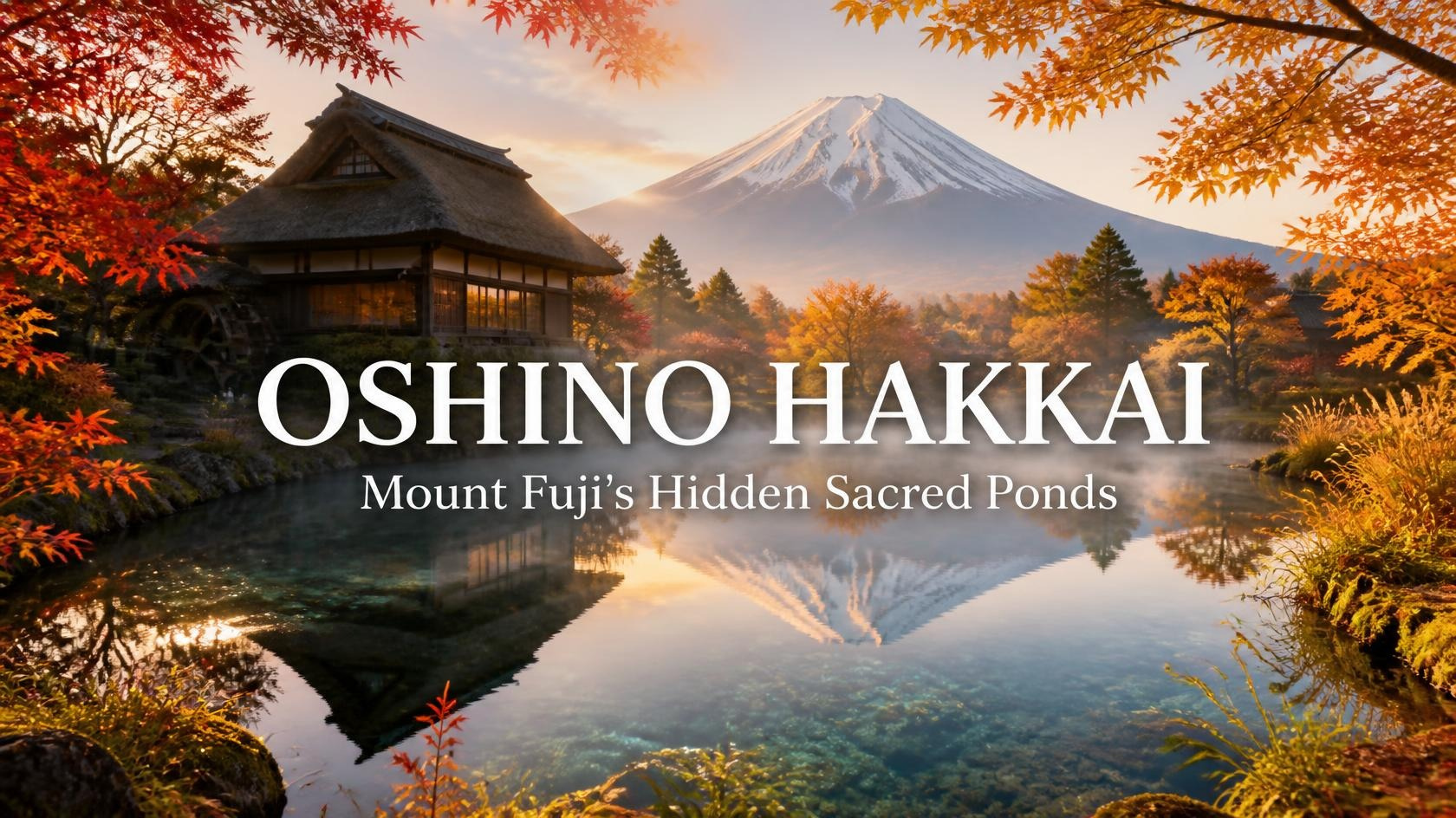
There is a moment — and if you visit at the right time of day, you will know exactly when it arrives — when the surface of Kagami-ike goes completely still, the morning mist lifts off the water, and Mount Fuji appears in the reflection so perfectly that you genuinely cannot tell which way is up. No guardrails crowd your frame. No tour buses idle in the background. Just volcanic spring water so clear you can see individual pebbles eight metres below the surface, and the most iconic mountain on Earth floating silently above it all.
This is Ōshino Hakkai (忍野八海), and it is one of the most extraordinary natural and cultural sites in Japan — yet it remains almost entirely absent from English-language travel writing. While Chureito Pagoda fills every traveller’s Instagram feed and the Fuji Five Lakes draw the bulk of the region’s tourists, Ōshino sits quietly in a shallow basin just east of Lake Kawaguchi, hiding in plain sight.
The name translates simply as “the eight seas of Ōshino.” Fed by snowmelt that percolates through the volcanic strata of Mount Fuji for over 80 years before surfacing here, the eight ponds are classified as a UNESCO World Heritage Site component and designated as one of Japan’s top 100 water bodies. The water that bubbles up in these pools fell as snow on Fuji’s summit when your grandparents were young. That thought alone gives this place a sacred, almost vertiginous feeling.
And for anime fans? Ōshino Hakkai holds a special secret. The peaceful countryside imagery that defines Studio Ghibli’s “The Wind Rises” (風立ちぬ, Kaze Tachinu) — the mirror-calm ponds, the thatched farmhouses, the sense of a Japan untouched by the modern century — draws direct visual inspiration from this very village. Walking the gravel path between the ponds, it is impossible not to hear Jiro Horikoshi’s dreamy inner monologue drifting across the water.
This guide will take you through all eight sacred ponds, give you the photography intel you won’t find anywhere else, introduce the genuinely irreplaceable local food, and get you here from Tokyo without wasting a single minute of your day.
- Quick Summary
- The Eight Sacred Ponds of Ōshino Hakkai
- 1. Deguchi-ike (出口池) — The Gateway Pool
- 2. Sokonashi-ike (底無し池) — The Bottomless Pond
- 3. Okama-ike (お釜池) — The Cauldron Pond
- 4. Kagami-ike (鏡池) — The Mirror Pond
- 5. Nakanokura-ike (中の倉池) — The Middle Storehouse
- 6. Nishine-ike (濁池) — The Turbid Pond
- 7. Banjo-ike (bancroft池 / 万寿池) — The Longevity Pond
- 8. Shobu-ike (菖蒲池) — The Iris Pond
- The Food You Will Not Find Anywhere Else
- Practical Travel Tips
- Conclusion: The Japan That Miyazaki Remembers
Quick Summary
| Detail | Info |
|---|---|
| Location | Ōshino Village, Minami-Tsuru District, Yamanashi Prefecture |
| Nearest Station | Kawaguchiko Station (Fujikyūkō Line) |
| Entry | Free for most ponds; small preservation fee (¥200) for the main cluster |
| Best Season | Late October – early November (autumn foliage + Fuji cap snow); early morning year-round |
| Best Time of Day | 6:30–8:30 AM (calm water, soft light, no crowds) |
| Ghibli Connection | Visual inspiration for The Wind Rises (2013) |
| Must-Eat | Hoba-miso grilled trout, warabi-mochi |
| Day Trip From | Shinjuku (~2 hrs), Kawaguchiko Station (~20 min by bus/taxi) |
| Accommodation Base | Kawaguchiko / Fujiyoshida area |
The Eight Sacred Ponds of Ōshino Hakkai
The ponds are divided into two loose clusters separated by a short walk through the village. Five of them — Deguchi-ike, Sokonashi-ike, Okama-ike, Kagami-ike, and Nakanokura-ike — form the main preserved area near the old thatched-roof farmhouses. The remaining three — Nishine-ike, Banjo-ike, and Shobu-ike — sit slightly further out and are visited by almost no foreign tourists, making them arguably the most photogenic of all.
1. Deguchi-ike (出口池) — The Gateway Pool
Deguchi means “exit,” and this pond sits at the outflow edge of the main cluster, though most visitors paradoxically encounter it first. It is the largest of the eight and has a slightly wilder, more forested feel than its neighbours — the overhanging branches create dappled light patterns on the surface that reward patient photographers.
The photography angle: Position yourself on the northern bank in early morning to catch the faint outline of Fuji over the treeline. A polarising filter is enormously helpful here to cut through surface reflections when the sun is higher.
Access
From Kawaguchiko Station, take the Fujikyu Bus (Route 73 or the Ōshino Hakkai-bound service) and alight at the Ōshino Hakkai stop. The journey takes approximately 20 minutes. Alternatively, a taxi from Kawaguchiko Station costs around ¥1,800–¥2,200 and takes 15 minutes — well worth it if you’re aiming for the pre-dawn window. If you’re coming directly from Tokyo, highway buses from Shinjuku Expressway Bus Terminal to Fujisan Station or Kawaguchiko take approximately 1 hour 45 minutes to 2 hours. You can book comfortable reserved seats and skip-the-line tickets here
Autumn/Season Tip
In late October, the maples fringing Deguchi-ike turn a deep amber-red, and if you arrive before 7 AM on a calm morning, you will have the entire pond to yourself. The water temperature remains a constant 13–14°C year-round, meaning the surface fog that forms on cold autumn mornings creates an almost mystical atmosphere that is genuinely unlike any photograph you have seen.
2. Sokonashi-ike (底無し池) — The Bottomless Pond
Its name means “bottomless,” and while that is not literally true, the extraordinary clarity of the water — combined with the deep blue-green hue caused by light scattering through mineral-rich volcanic sediment — creates the optical illusion that the pond descends infinitely. This is a spiritual site; a small shrine sits at its edge, and local legend holds that the pond is connected underground to Lake Kawaguchi.
The photography angle: Shoot straight down from the wooden observation platform at high noon when the sun penetrates directly to the bottom. The pale gravel floor seems to glow.
Access
A three-minute walk from Deguchi-ike along the main gravel path through the preserved village area.
Autumn/Season Tip
The surrounding landscape is open enough that on clear days from October through February, Mount Fuji’s snowcap is reflected here with extraordinary sharpness. Winter mornings (December–January) produce the crispest reflections of any season, though you will need serious cold-weather layers.
3. Okama-ike (お釜池) — The Cauldron Pond
Named for its resemblance to a traditional iron cooking pot (okama), this is one of the smallest ponds but arguably one of the most intense in colour. The turquoise is so saturated it looks digitally enhanced in photographs — except it isn’t. The colour comes from the unique mineral composition of the Fuji aquifer interacting with the specific depth and basin shape here.
The photography angle: A wide-angle lens from the southern bank captures the thatched farmhouse (kayabuki roof) in the background — the single most “Ghibli frame” available at Ōshino Hakkai and a direct visual echo of The Wind Rises.
Access
A two-minute walk from Sokonashi-ike; all within the same preserved cluster.
Autumn/Season Tip
The thatched farmhouse backdrop looks its absolute best in mid-November when the surrounding ginkgo trees are at peak golden yellow. This two-week window is perhaps the single most beautiful moment in Ōshino’s annual calendar.
4. Kagami-ike (鏡池) — The Mirror Pond
This is the one. If you have time for only one pond, make it Kagami-ike. Kagami means “mirror,” and on a calm morning this shallow, perfectly positioned pond delivers the textbook Mount Fuji reflection — symmetrical, unobstructed, and with the soft colours of sunrise playing across the water’s surface. Even seasoned Japan photographers tend to lose composure the first time they see it.
The photography angle: Arrive at sunrise and position yourself on the western bank, shooting east-to-west with Fuji centred over the water. Use a tripod and a remote shutter release. Wait. Breathe. The mountain will come to you.
Access
Within the main preserved cluster, a two-minute walk from Okama-ike.
Autumn/Season Tip
The optimal morning for Kagami-ike occurs roughly three to five days after a typhoon or heavy rain has cleared, when atmospheric particulates have been washed away and Fuji appears almost three-dimensional against a deep cobalt sky. Check the Yamanashi Prefecture weather radar the evening before your visit.
5. Nakanokura-ike (中の倉池) — The Middle Storehouse
Slightly apart from the central cluster, Nakanokura-ike has a quieter, more contemplative atmosphere. The wooden bridges crossing its outflow channels and the small farmland plots surrounding it give a genuine sense of Japanese satoyama — the intimate landscape where human settlement and nature exist in long negotiation with each other. This is the Ghibli feeling at its most concentrated.
Access
A five-minute walk from the main cluster, following the signs toward the secondary pond area.
Autumn/Season Tip
Harvest season in late September and early October brings local farmers to the rice paddies adjacent to this pond. The combination of golden rice stalks, turquoise water, and Fuji on the horizon is the stuff of dreams for a documentary or travel photographer.
6. Nishine-ike (濁池) — The Turbid Pond
Here is where Ōshino Hakkai diverges from its polished postcard image and becomes genuinely interesting. Nishine-ike is the only one of the eight ponds that is slightly murky — fed by a different subsurface channel, it has a more earthen, greenish quality. Most tour groups skip it entirely. Don’t. The isolation and the overgrown banks give it a primordial quality, and the contrast between this and Kagami-ike’s crystalline perfection reminds you that these are living, breathing geological features, not ornamental pools.
Access
A 10-minute walk from the main cluster, heading north through the village residential streets. Follow the small blue-and-white Hakkai signboards.
Autumn/Season Tip
Because it sits in a slightly lower hollow, morning mist lingers longest over Nishine-ike in autumn — sometimes until 9 AM. Atmospheric and moody in the best possible way.
7. Banjo-ike (bancroft池 / 万寿池) — The Longevity Pond
Banjo (万寿) relates to long life and prosperity, and this pond has historically been associated with agricultural prayers and rituals. It is fringed with reeds and water plants that, in spring, host dragonflies and frogs in extraordinary numbers. In autumn, the reeds turn a warm amber that beautifully complements Fuji’s grey-white crown overhead.
Access
Adjacent to Nishine-ike on the northern outer circuit.
Autumn/Season Tip
Visit in November when the reed beds have turned completely golden. Shoot with the sun behind you in the afternoon for the warmest tones.
8. Shobu-ike (菖蒲池) — The Iris Pond
The final pond is named for the Japanese iris (shobu) that blooms in profusion along its banks in late May and June — but it earns its place on any season’s itinerary. The surrounding open meadow gives Shobu-ike the widest, most unobstructed view of any of the eight ponds, and the silhouette of Fuji from this angle, slightly to the northwest, is dramatically different from the more frontal views available at the main cluster.
The photography angle: Late afternoon, shooting northwest, with the low autumn sun casting long shadows across the meadow and illuminating the water like hammered gold.
Access
A five-minute walk from Banjo-ike; completes the outer circuit loop back toward the main entrance.
Autumn/Season Tip
Shobu-ike is the furthest pond from the tourist infrastructure, which means by the time most visitors have finished the main cluster and retreated to the food stalls, you can have this entire meadow to yourself. In October and November, that solitude is extraordinarily precious.
The Food You Will Not Find Anywhere Else
The ring of small stalls and family-run shops immediately outside the main Ōshino Hakkai cluster serves two dishes that are genuinely irreplaceable and virtually unknown outside Japan.
Hoba-miso grilled trout (hoba-yaki masu) is the essential Ōshino experience. The trout — rainbow and cherry salmon varieties — are raised in the spring water of the ponds themselves, giving the flesh an extraordinarily clean, mineral sweetness. They are skewered whole, lacquered with a miso paste mixed with mountain vegetables and laid onto a dried magnolia leaf (hoba), then grilled over charcoal. The result is smoky, sweet-savoury, and completely unlike anything available in Tokyo restaurants. Each stall has a different miso recipe handed down through the family. Walk the stalls before choosing — the smells will guide you.
Warabi-mochi made from locally harvested bracken fern (warabi) starch is the other must-try. Real warabi-mochi — as opposed to the sweet potato or potato starch imitations sold almost everywhere else in Japan — has a darker, earthier, slightly more elastic texture and a subtle bitterness that the dusting of roasted soybean flour (kinako) and kuromitsu black sugar syrup perfectly balances. Several stalls here sell the genuine article, and you will taste the difference immediately.
Practical Travel Tips
Getting Here from Tokyo:
The most efficient route is the highway bus from Shinjuku Expressway Bus Terminal (Busta Shinjuku) to Kawaguchiko Station, taking approximately 1 hour 45 minutes to 2 hours. From Kawaguchiko, take the Fujikyu Bus to the Ōshino Hakkai stop (20 min, ¥490) or a taxi. To guarantee your seat on the highway bus — especially on autumn weekends — book your reserved seats in advance
Getting Here from Kawaguchiko:
Bus Route 73 (Fujikyu Highland Bus) connects Kawaguchiko Station to Ōshino Hakkai in approximately 20 minutes. Buses run roughly every 30–60 minutes. A day-use IC card (Suica/Pasmo) is accepted.
Photography Logistics:
– Arrive by 6:30 AM in summer, 6:00 AM in autumn for the pre-crowd, calm-water window.
– A polarising filter is essential for cutting surface glare on all eight ponds.
– The main cluster is best lit from the north in the morning; the outer ponds (Banjo, Shobu) are best in late afternoon.
– Drone flight is prohibited in the main cluster. Respect this — it is a UNESCO Heritage component site.
Combining with Other Spots:
Ōshino Hakkai pairs perfectly with a half-day at nearby Fujiyoshida’s Chureito Pagoda (15 min by taxi) or the Fuji-Q Highland theme park for anime fans who want to follow up a contemplative morning with a slightly more kinetic afternoon. Alternatively, the Kawaguchiko Music Forest and lakeside cycling routes make for a complete and satisfying full-day Fuji-area itinerary.
Where to Stay:
The Fuji Five Lakes area, centred on Kawaguchiko, offers everything from budget guesthouses to full ryokan (traditional inn) experiences with open-air hot spring baths facing the mountain. For the Ōshino Hakkai experience specifically, staying on the eastern shore of Kawaguchiko keeps you close to the ponds while giving you classic Fuji lake views from your window. Browse the best-value lakeside ryokan and hotels for your dates
Conclusion: The Japan That Miyazaki Remembers
There is a line in The Wind Rises — spoken over an image of still water and a distant mountain — that captures Ōshino Hakkai more precisely than any travel article can: “Japan is a poor country. Shabby, but beautiful.” Hayao Miyazaki was not describing poverty of spirit. He was describing the particular beauty that exists in things that have not been glossed, packaged, or optimised for consumption.
Ōshino Hakkai is that beauty, made liquid and given eight distinct forms. The water is 80 years old. The trout are fed by Fuji’s snowmelt. The warabi in your mochi was harvested from the surrounding hills by someone who knows this land by name. The reflection in Kagami-ike has been there, perfectly assembled, waiting for you, since long before anyone thought to post it on Instagram.
Come early. Bring a tripod. Eat the trout. And sit, for just a few minutes, at the edge of the mirror pond and watch a mountain that has been watching this valley for ten thousand years.
It will be, without question, one of the most quietly extraordinary mornings of your time in Japan.


コメント