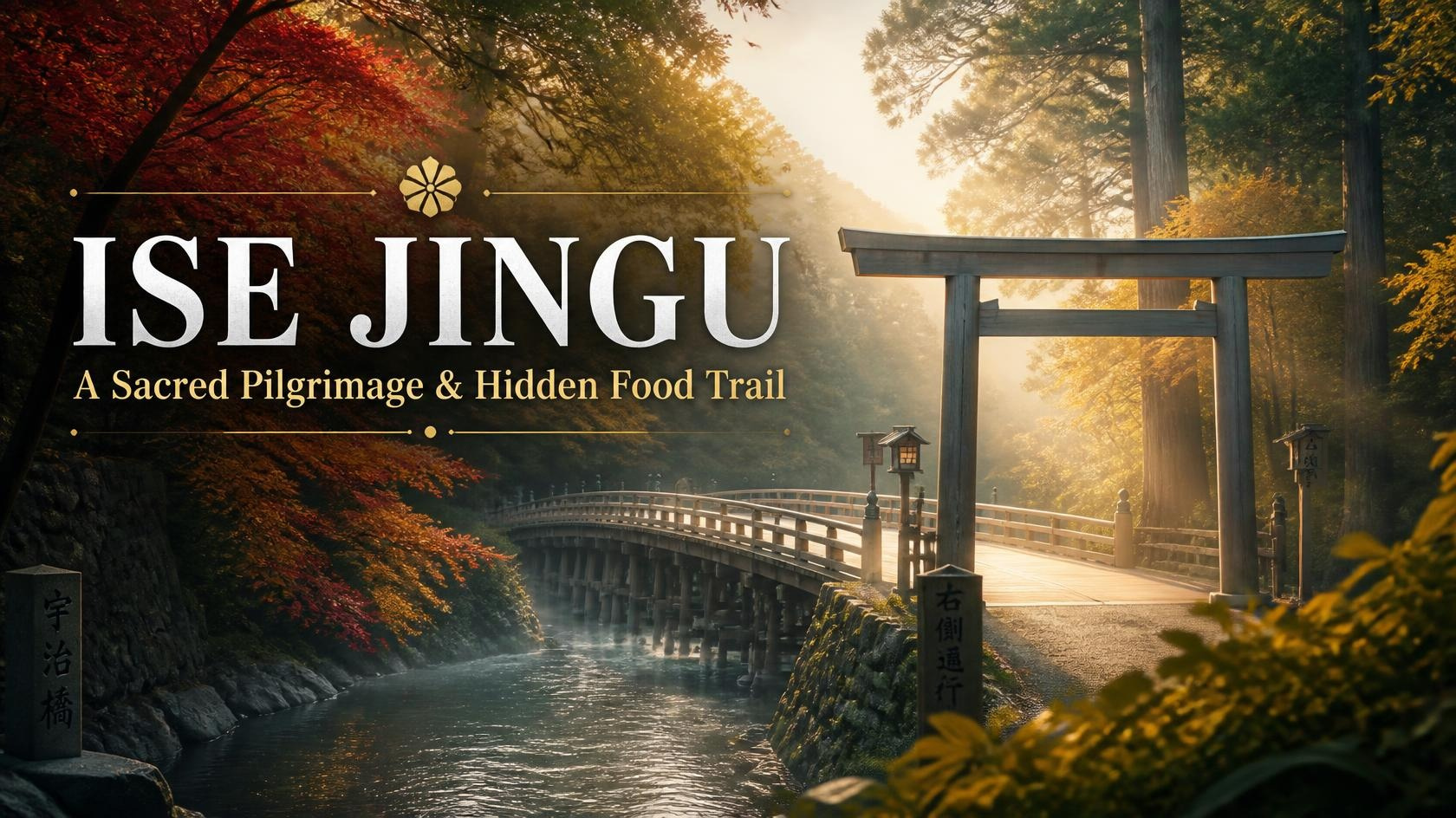
Ise Jingu & Okage Yokocho: A “Your Name” Pilgrimage and the Hidden Food Trail Most Tourists Never Find
There is a moment on the forested approach to Ise Grand Shrine — somewhere between the third wooden torii gate and the soft curve of the Isuzu River — where the modern world simply dissolves. The gravel crunches beneath your feet. Ancient cedar trees press in from either side, their canopies blocking the sky in a way that feels less like shade and more like a threshold. If you have ever watched Makoto Shinkai’s Your Name (Kimi no Na wa) and felt the magnetic pull of its spirit-world architecture — the weathered timber, the sacred rope, the silence that hums — then standing here will feel less like sightseeing and more like arriving somewhere you have already been.
Most international travellers treat Ise as a half-day detour: snap a photo at the outer torii, walk briskly to the main hall, turn around. What they miss entirely is the living, breathing world that exists just beyond the shrine’s Uji Bridge — a centuries-old merchant laneway called Okage Yokocho that remains, astonishingly, almost entirely off the international tourist radar. And within that laneway: three dishes so specific to this single stretch of the Mie coastline that eating them anywhere else is, by definition, a pale imitation.
This is a guide for the curious — anime fans chasing a cinematic ghost, food travellers willing to go slightly off-script, and anyone who suspects that the most memorable experiences in Japan are always the ones the guidebooks mention in a single sentence.
- Quick Summary
- 1. Ise Jingu (Naiku — Inner Shrine): Walking Into “Your Name”
- 2. Okage Yokocho: Japan’s Most Atmospheric Lane That the World Forgot
- 3. The Ise Food Trail: Three Dishes You Cannot Eat Anywhere Else on Earth
- Travel Tips: Getting to Ise from Nagoya or Osaka
- Conclusion: The Pilgrimage You Didn’t Know You Were Taking
Quick Summary
| Details | |
|---|---|
| Prefecture | Mie Prefecture |
| Best season | Autumn (October–November) for foliage; Spring (March–April) for cherry blossoms along the Isuzu |
| Closest stations | Iseshi Station (Kintetsu/JR) or Ujiyamada Station (Kintetsu) |
| From Nagoya | ~1h 30m via Kintetsu Limited Express (Iseshi or Ujiyamada) |
| From Osaka (Namba) | ~1h 40m via Kintetsu Limited Express (Ujiyamada) |
| Must-eats | Tekone-zushi, akafuku mochi, ise udon |
| Anime connection | Ise Jingu (Naiku) — real-world inspiration for Your Name spirit-world architecture |
| Free entry? | Ise Jingu grounds: free. Okage Yokocho: free to enter (pay per food stall) |
| Recommended time | Full day (6–8 hours) |
1. Ise Jingu (Naiku — Inner Shrine): Walking Into “Your Name”
Long before Your Name became a global phenomenon, Makoto Shinkai had spoken openly about his reverence for Japan’s ancient sacred spaces — the quality of light that seems to filter through shrine forests differently from anywhere else, the feeling that the architecture is not merely old but alive, still in conversation with something invisible. The Naiku (Inner Shrine) of Ise Jingu is among the most frequently cited real-world references for the spirit-world imagery woven throughout the film, and walking its approach, called the Ujibashi-sando, makes that creative debt unmistakably clear.
The journey begins at the Uji Bridge, a 101.8-metre wooden span over the Isuzu River that marks the boundary between the secular world and the sacred precinct. Cross it slowly. The pale timber, the soaring torii on either bank, and the river glittering below — this is a composition Shinkai could have lifted directly onto a storyboard frame. Beyond the bridge, the path curves into a cedar forest that is classified as a chinju no mori (shrine woodland), some trees over a thousand years old. The air quality changes noticeably; the sound of the river fades and is replaced by something closer to a held breath.
The main hall, Kotaijingu, enshrines Amaterasu-Ōmikami, the sun goddess and ancestor of the imperial family, and is considered the most sacred site in all of Shinto. You cannot enter the inner precincts — a series of wooden fences and draped white cloth conceal the innermost structure entirely, reinforcing a sense of sacred distance that actually intensifies the atmosphere rather than frustrating it. This, too, feels like a Shinkai scene: the thing that matters most is just beyond the frame.
Allow at least 45 minutes to an hour to walk the full approach, explore the subsidiary shrines (the Aramatsuri-no-miya sub-shrine nearby rewards the extra 10 minutes of walking), and simply sit by the river. Bring a physical camera if you have one — the dappled cedar light is extraordinary in any season, but transcendent in autumn.
Access
From Iseshi Station (Kintetsu or JR), take the Sanbashi/Naiku-bound Mie Kotsu bus from Bus Stop 11 (approximately 12 minutes, ¥410). From Ujiyamada Station (Kintetsu), the bus journey is slightly shorter. Taxis are also available from both stations. The Uji Bridge entrance is the main access point for Naiku.
Autumn/Season Tip
From mid-October through early November, the maple and ginkgo trees lining the Isuzu River turn a deep amber-gold that reflects in the water below the Uji Bridge. Arrive before 8:00 a.m. to experience the forest approach in near-silence and soft morning light — the atmosphere is genuinely other-worldly. If you are visiting in early spring (late March), the riverbank cherry blossoms frame the bridge in a way that almost feels cinematically unfair.
2. Okage Yokocho: Japan’s Most Atmospheric Lane That the World Forgot
Step back through the Uji Bridge, turn right along the river, and within three minutes you will find yourself standing at the entrance to a place that most international tourists walk straight past: Okage Yokocho, a lovingly reconstructed Edo-to-Meiji-period merchant street that runs for approximately 800 metres along the southern bank of the Isuzu River, directly adjacent to the Naiku approach.
The name translates roughly as “Thanks-to-You Alley” — a reference to the okagemairi pilgrimage boom of the Edo period, when millions of ordinary Japanese people made the journey to Ise on foot, and the merchants here fed, clothed, and housed them with cheerful commerce. The current streetscape, rebuilt in the 1990s to meticulous period specifications, has avoided the tourist-trap fate of similar reconstructions elsewhere in Japan. The lanterns are real flame. The wooden shopfronts are weathered correctly. The flagstones are uneven in the way that only genuine age or deeply respectful craftsmanship can produce.
What makes Okage Yokocho remarkable for international visitors is precisely its obscurity. On any given weekday morning, the lane is populated almost entirely by Japanese domestic tourists — older couples from Nagoya, school groups on field trips, solitary pilgrims eating senbei beside the river. There are no English-language tour groups, no selfie-stick rental shops, and no matcha soft-serve outposts trying to lure you away from the actual food culture. Everything sold here is either local, traditional, or both.
The best way to experience Okage Yokocho is to wander it twice: once quickly, to get the lay of the land and identify the stalls whose queues tell you where the quality is; and once slowly, with food in hand, using the river-facing benches to eat, watch, and absorb. Book a guided Ise Jingu and Okage Yokocho experience in advance to get the historical and cultural context that transforms the lane from picturesque to genuinely profound. book an English-guided walking tour here.
Access
Okage Yokocho is a five-minute walk from the Naiku (Inner Shrine) bus stop, immediately south of the Uji Bridge. There is no admission fee to enter the laneway itself.
Autumn/Season Tip
The laneway runs paper lanterns at dusk year-round, but in autumn the falling maple leaves collect on the flagstones in a way that makes the street look like a woodblock print. If you can stay until late afternoon, the golden-hour light through the cedar-beamed shopfronts is extraordinary. Note that some smaller stalls close by 5:00 p.m., so time your food walk for mid-morning to mid-afternoon.
3. The Ise Food Trail: Three Dishes You Cannot Eat Anywhere Else on Earth
Ise’s culinary identity is as specific and quietly proud as the shrine itself. The three dishes below are not fusion experiments, not modern reinventions — they are unchanged, deeply local, and available in their truest form only here.
Tekone-zushi: The Bold, Soy-Marinated Sushi of the Fishermen
Tekone-zushi was born from necessity. Fishermen who caught skipjack tuna (katsuo) off the Mie coast had no time to prepare elaborate meals, so they marinated the fish in soy sauce and sake, then pressed it by hand into cooked rice — te (hand) kone (kneading). The result is a sushi experience entirely unlike anything in Tokyo or Osaka: the rice is warm, slightly sweet, and yielding; the fish is bold and deeply umami-forward from the marinade; and the garnish of ginger and shiso cuts through the richness with a clean herbal sharpness.
Several restaurants in and around Okage Yokocho serve tekone-zushi as a set meal. Look for Sueyoshi or similar established restaurants in the laneway — lines form early at lunch, so aim to queue by 11:30 a.m. A full tekone-zushi set, which typically includes miso soup, pickles, and small sides, runs approximately ¥1,800–¥2,500.
Akafuku Mochi: A 300-Year-Old Recipe, One Authorised Shop
Akafuku mochi is one of Japan’s most fiercely protected regional confections. A pillow of soft, lightly salted gyuhi (rice cake) is draped in smooth red-bean paste (an), shaped to represent the gentle flow of the Isuzu River, and sold — critically — only at the original Akafuku shop in Okage Yokocho and a small number of affiliated kiosks within Mie Prefecture. It is not available online. It is not available outside the prefecture. It is not reproducible by any other confectioner. You must come here.
The Akafuku shop in Okage Yokocho is a two-storey wooden building with an open front where you can watch the mochi being shaped by hand. Order a small plate of three pieces (¥680) and eat them immediately on the wooden terrace overlooking the Isuzu — they are best consumed within a few hours of being made. A boxed set is available to take home, but the magic is in eating them here, still warm and impossibly soft, with the sound of the river below.
Ise Udon: The Pillowy Noodle That Breaks Every Udon Rule
If you believe udon must be firm, springy, and served in a clear dashi broth, ise udon will politely challenge everything you know. The noodles are thick — much thicker than standard udon — and cooked far longer, until they become soft, almost marshmallowy, with a texture that is deeply comforting rather than chewy. They are served in a very small amount of intensely dark, sweet-savoury tamari-based tare sauce, topped simply with sliced spring onion. That is it. No broth. No tempura. No garnish theatre. Just noodle and sauce in profound conversation.
Ise udon is available at numerous restaurants throughout Okage Yokocho and the surrounding town. Look for Yamatokan or any shop displaying hand-painted noren (fabric dividers) featuring noodle imagery. A bowl costs approximately ¥600–¥900 and is the perfect light lunch before or after a more substantial tekone-zushi set.
Travel Tips: Getting to Ise from Nagoya or Osaka
From Nagoya
The fastest and most comfortable route is the Kintetsu Limited Express from Nagoya Station (Kintetsu Nagoya Station, underground, separate from JR) to Ujiyamada Station. Journey time is approximately 1 hour 30 minutes, with departures roughly every 30 minutes throughout the day. A reserved seat (strongly recommended) costs approximately ¥2,860. Book Kintetsu Limited Express seats for the best value if you plan to explore the wider Mie region.
From Osaka (Namba)
The Kintetsu Osaka Line Limited Express from Osaka Namba Station (Kintetsu Namba Station) to Ujiyamada Station takes approximately 1 hour 40 minutes and costs around ¥3,160 with a reserved seat. This is considerably more comfortable and only marginally slower than going via JR to Nagoya and doubling back.
General Tips
- IC Card: Both Kintetsu and JR are accessible with IC cards (Suica, ICOCA, Manaca), but Limited Express reserved seat supplements must be purchased separately at the ticket window or via the Kintetsu app.
- Start early: The Naiku approach and Okage Yokocho are busiest between 10:00 a.m. and 2:00 p.m. on weekends. Arriving by 8:30 a.m. gives you the forest atmosphere almost entirely to yourself.
- Cash: Many small stalls in Okage Yokocho are cash-only. Carry at least ¥5,000 in small bills.
- Stay overnight in Ise: If budget allows, spending the night transforms the experience. The atmosphere of the laneway at dusk, with paper lanterns glowing and the crowds gone, is something that a day trip simply cannot provide. Find the best-rated guesthouses and traditional inns near Ise Jingu for options ranging from budget-friendly guesthouses to full kaiseki-dinner ryokan.
- Dress comfortably: The full Naiku approach plus Okage Yokocho involves 4–6 kilometres of walking on gravel and stone. Bring comfortable shoes and a light bag.
Conclusion: The Pilgrimage You Didn’t Know You Were Taking
There is a reason Makoto Shinkai returned, again and again in his visual imagination, to the architecture and atmosphere of Japan’s sacred spaces. It is the same reason that pilgrims have been walking to Ise for over a thousand years, and the same reason that the merchants of Okage Yokocho built their livelihoods along a laneway beside a river just outside a shrine forest: some places hold something that is genuinely difficult to name, and human beings are drawn to them across centuries and cultures without quite being able to explain why.
Ise is not a difficult trip. It is not an obscure or gruelling pilgrimage. It is, in fact, remarkably easy to reach from two of Japan’s major cities. What it requires is simply the decision to go one stop further than most tourists do — past the shrine photograph, past the gift-shop postcard — and into the laneway where a woman is still shaping akafuku mochi by hand the same way her predecessors shaped it three hundred years ago, and where a bowl of impossibly soft noodles in a dark, sweet sauce is waiting to make you question everything you thought you knew about Japanese food.
Go for the cinema. Stay for the mochi. Leave with something you cannot quite name but will spend years trying to find again.

コメント