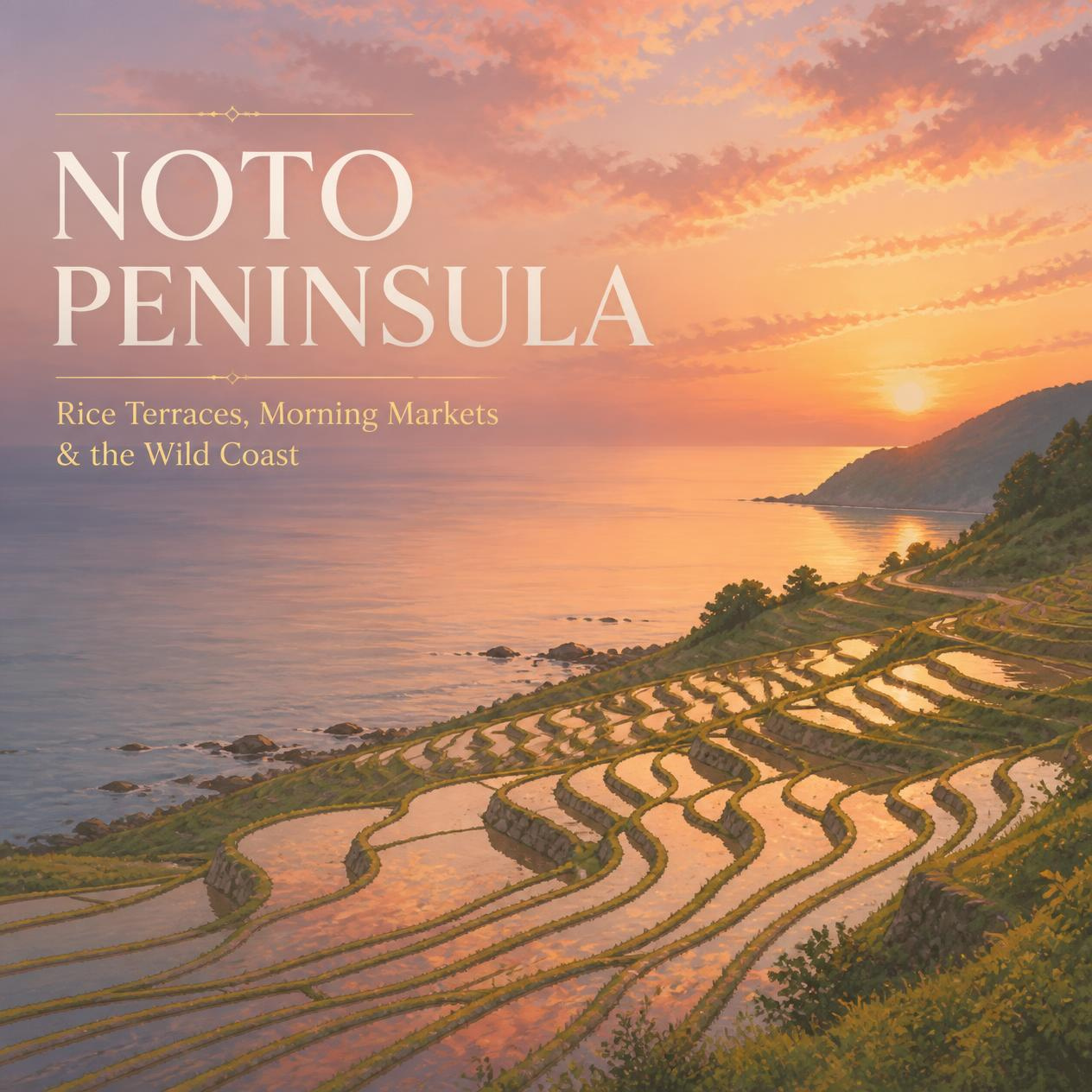
Noto Peninsula, Ishikawa: The Ultimate Guide to Shiroyone Senmaida, Wajima Asaichi & the Noto Kongo Coastline
There is a kind of beauty in Japan that refuses to be rushed. It doesn’t live in the lobby of a Kyoto hotel or the neon corridors of Akihabara. It lives on a rugged finger of land jutting 100 kilometres out into the grey-green Sea of Japan, where rice terraces cascade straight into the ocean, lacquerware artisans have perfected their craft across 400 years, and sea caves swallow the sound of the waves whole. This is the Noto Peninsula — Ishikawa Prefecture’s best-kept secret, and one of the most cinematic, emotionally resonant destinations in all of Japan.
For anime fans, Noto is already encoded in your imagination. The wild, wave-battered cliffs of the Noto Kongo coastline carry the same moody, supernatural tension as the coastal settings of Nagi no Asukara. The flooded rice terraces of Shiroyone Senmaida at golden hour, perfectly mirroring the sky, look lifted frame-for-frame from a Studio Ghibli storyboard. And the weathered fishing town of Wajima — its morning market still alive with the cries of vendors, its lacquerware workshops still lit by the glow of urushi resin — holds the living soul of a Japan that most visitors never find.
Important Notice for 2025–2026 Visitors: The Noto Peninsula was struck by a powerful magnitude 7.6 earthquake on January 1, 2024, causing devastating damage to Wajima and surrounding areas. Recovery is ongoing, and the situation on the ground continues to evolve. Please check official tourism sources and local operator websites before your trip, as conditions may differ from those described here. Visiting now is also a meaningful act of support for local communities working hard to rebuild.
- Quick Summary
- 1. Shiroyone Senmaida (白米千枚田) — A Thousand Rice Paddies at the Edge of the World
- 2. Wajima Asaichi & Wajima-Nuri Lacquerware — Japan’s Living Morning Market
- 3. Ganmon Sea Cave & Hatago-iwa — The Wild Coast That Anime Forgot to Cite
- Travel Tips for Visiting the Noto Peninsula
- Conclusion
- Sources
Quick Summary
| Spot | Best For | Entry Fee | Hours |
|---|---|---|---|
| Shiroyone Senmaida Rice Terraces | Sunrise photography, autumn LED illumination | Free (outdoor) | Always open; rest house hours vary |
| Wajima Asaichi (Morning Market) | Fresh seafood, lacquerware shopping, local atmosphere | Free | 8:00 a.m. – 12:00 noon |
| Ganmon Sea Cave & Hatago-iwa, Noto Kongo | Coastal drama, sightseeing boat cruise | Walkway free; boat from ¥1,200 adults | Boat: mid-March to mid-November, 9:00 a.m. – 4:00 p.m. |
Getting to Noto: The most practical base is Kanazawa, which is connected to Tokyo by Hokuriku Shinkansen (approx. 2.5 hours). From Kanazawa, the Noto Peninsula is best explored by rental car or the Wajima Express Bus. A rental car is strongly recommended — it gives you the freedom to stop at every coastal viewpoint along the way and is essential for reaching Ganmon and Shiroyone Senmaida in a single day.
1. Shiroyone Senmaida (白米千枚田) — A Thousand Rice Paddies at the Edge of the World
Why It’s Worth Visiting
Most destinations described as “breathtaking” don’t earn the word. Shiroyone Senmaida does. More than 1,000 small terraced rice paddies — the remaining count stands at 1,004 — are carved into a steep coastal hillside on the northernmost tip of the Noto Peninsula, stacked so tightly against each other that from above they look like a shattered mirror reflecting the sea. They are too small and irregular for any machinery; every rice plant here is put in the ground and pulled out by human hands. That is not a tourism gimmick. It is simply the only way it can be done.
The site is designated both a National Scenic Beauty Spot and part of the United Nations’ Globally Important Agricultural Heritage System — recognition that this is not just a pretty view, but a living agricultural culture of global significance. What no designation can fully capture, however, is what it feels like to stand at the observation terrace at 5:30 a.m. in late April, watching the flooded paddies turn into a perfect mirror of the rose-pink sky, each terrace reflecting a slightly different shade, the whole hillside glowing between the dark sea and the brightening horizon. If that image doesn’t activate whatever part of your brain stores Ghibli frames, nothing will.
From mid-October through mid-March, after the harvest is in, the terraces are lit at night with 25,000 solar-powered, colour-changing LED lights — an event called “Aze no Kirameki” (Glistening Ridgepaths). Photographs of this illumination spread quietly through Japanese social media for years before international travellers caught on. In winter, the hillsides are sometimes blanketed in snow while the LEDs glow beneath the white, creating an otherworldly scene straight from the coldest, most beautiful episode of any anime you’ve loved.
Access
The most practical way to reach Shiroyone Senmaida is by rental car from Kanazawa, approximately 2.5 to 3 hours along the coastal road. There is a large parking lot directly beside the observation area and rest house.
By public transport, take the Wajima Express Bus from Kanazawa Station (approximately 2 hours 30 minutes) and alight at the Wajima-eki-mae bus stop. From there, transfer to the Hokutetsu Bus Machino Line and ride to the Shiroyone Senmaida stop. Bus frequency is limited and the timetable changes seasonally, so verify schedules carefully before your trip on the Hokutetsu Bus website.
Alternatively, from Wajima Station, the terraces are about 8 km and can be reached in approximately 30 minutes on an electrically assisted rental bicycle — a genuinely beautiful ride with panoramic views of the Sea of Japan along the way.
Best Time to Visit — and When to Avoid It
Each season delivers something completely different. Late April to mid-July is arguably the visual peak: the paddies are flooded for planting season, and at sunrise or sunset the water surface becomes a perfect mirror, creating an “infinity pool” effect where the paddies seem to merge seamlessly with the sea beyond. Arrive before 6:00 a.m. to have the terrace almost entirely to yourself.
Summer through early September brings vivid green as the rice grows, ripening to gold in August and early September just before harvest — the warm-toned palette of a classic anime countryside sequence.
Mid-October to mid-March is LED illumination season. The light show begins at dusk and runs until around 9:00 p.m. (check the official Wajima city tourism site for exact times as they adjust seasonally). This period draws domestic visitors, particularly on weekends. Expect traffic on the coastal road during autumn holidays (mid-October to early November). Weekday evenings during LED season are noticeably quieter.
Avoid peak Golden Week (late April to early May) if you dislike crowds — the parking lot fills quickly and the hillside observation area can become congested by mid-morning.
Practical Notes
- The outdoor terraces are freely accessible at all hours; there is no admission charge.
- The adjacent roadside rest house and shop, which sells local rice, snacks, and agricultural products, has its own opening hours that vary seasonally — check the official Wajima City tourism website before visiting if the shop is important to your plans.
- The paths between the terraces are narrow and can be extremely slippery after rain. Wear shoes with proper grip. This is especially critical in winter.
- Cash is the norm at the roadside shop.
- Photography of the terraces is unrestricted from the public observation area. Entering the paddies themselves is not permitted.
- Mobile signal can be weak in this area — download offline maps before leaving Wajima.
How to Combine Nearby Spots
Shiroyone Senmaida sits approximately 20 minutes by car northeast of central Wajima. A natural itinerary pairs a dawn visit to the terraces with the Wajima Asaichi Morning Market (which opens at 8:00 a.m.), giving you both experiences in a single morning. The coastal road between the two spots itself rewards slow driving, with several cliff-edge pullout points overlooking the sea. The Sosogi coast and the Tokikunike old samurai residence in Machino are also within 10–15 minutes of the terraces and make a relaxed afternoon addition.
2. Wajima Asaichi & Wajima-Nuri Lacquerware — Japan’s Living Morning Market
Why It’s Worth Visiting
The Wajima Asaichi (輪島朝市) is one of Japan’s three great morning markets, and the one with the longest unbroken human memory behind it. Its history reaches back more than 1,000 years to the Heian period, when locals would gather to barter fish for vegetables during shrine festivals — a trading culture so old it predates the concept of currency in this corner of Japan. Today, more than 200 stalls stretch along approximately 360 metres of Asaichi-dori, and the women who run them — wives of fishermen and farmers, many of them veterans of decades behind the same stall — carry that entire history in their voices.
What makes Wajima Asaichi different from any market you have visited elsewhere in Japan is that it is genuinely, stubbornly local. Stall positions are inherited from generation to generation. Items rarely have price tags — you negotiate, you chat, you taste. Fresh seafood hauled in from the port shares table space with hand-dried vegetables, egara manju (sweet bean-filled rice cakes), and pieces of Wajima-Nuri lacquerware that in Tokyo would cost three times the price.
This is also where you experience Noto Don — the region’s signature seafood rice bowl. Served in a lacquerware bowl of genuine Wajima-Nuri, it is typically heaped with whatever came off the boats that morning: glistening botan ebi (peony shrimp), snow crab, sashimi-grade nodoguro (blackthroat sea perch, a fatty, deeply flavoured local rockfish prized across the Sea of Japan), and sometimes iidako — small octopus simmered in sweetened soy. The combination of hyperlocal seafood in a bowl whose very vessel is a local craft object is something that simply cannot be replicated anywhere else. As one official tourism source puts it, the Noto Don experience is inseparable from the act of dining from Wajima lacquerware itself.
And then there is the lacquerware. Wajima-Nuri is recognised as one of the three great lacquerwares of Japan. Each piece passes through more than a hundred distinct production stages, built up from a wooden base covered with cloth, coated with jinoko (a traditional mixture of calcined diatomaceous earth, raw lacquer, and glue), and layered with lacquer across weeks or months of patient work. The result is a material of extraordinary durability that actually deepens in beauty over time. Lacquer itself comes from the sap of the urushi tree — only about 250 to 350 millilitres can be collected from a single mature tree, which makes the raw material itself precious before a single brush stroke has been applied. At the Wajima Kobo Nagaya craftsmen’s row house, five workshops under one roof offer visitors the chance to observe artisans at work and take part in hands-on chinkin (gold-inlay engraving) and maki-e (gold and silver lacquer decoration) experiences, including a popular “My Chopstick Making” course. book a hands-on Nuri experience here
The 2024 Earthquake and the Market’s Resilient Revival
No honest guide can write about Wajima Asaichi without acknowledging what happened on January 1, 2024. A magnitude 7.6 earthquake struck the Noto Peninsula, and the fires that followed destroyed approximately 300 buildings along Asaichi Street — the original home of the morning market for a thousand years. The devastation was compounded nine months later by severe flooding and landslides.
The market did not disappear. Just three months after the earthquake, members of the Wajima Morning Market Association set up a mobile pop-up market, first in Kanazawa and then back in Wajima itself, operating from the Power City Wajima Wai Plaza. As of late 2025, the original Asaichi Street site remains under reconstruction, with plans for a permanent, covered market plaza under discussion. Vendors have been returning gradually, and the spirit of the market — the inherited stalls, the negotiated prices, the women in headscarves calling out to passing shoppers — is very much alive.
Visiting Wajima now is not just tourism. It is a quiet act of solidarity with a community that has rebuilt its daily rhythms under extraordinary difficulty.
Always verify the current market location and vendors before your visit, as the reconstruction situation continues to evolve. The Wajima City Tourism Office (accessible via Michinoeki Wajima, where the express bus arrives) is the best first stop.
Access
From Kanazawa, take the Wajima Express Bus from Kanazawa Station (approximately 2 hours 30 minutes) to the Wajima-eki-mae bus stop, then walk approximately 10 minutes to the market area. By car from Kanazawa, allow approximately 2.5 to 3 hours.
If arriving from Shiroyone Senmaida by car, the market is approximately 20 minutes west along Route 249.
Best Time to Visit — and When to Avoid It
Arrive as early as possible — doors open at 8:00 a.m., but popular items (especially fresh seafood and hand-grilled dried fish) begin selling out by 9:00 a.m. when the crowd thickens noticeably. The ideal window is 8:00 to 9:00 a.m., when the stalls are fully set and the pace is still relaxed enough to actually talk with the vendors.
The market is closed on the second and fourth Wednesday of each month, and for three days at the new year. Never arrive on those days without checking.
Summer weekends draw the largest crowds; early weekday mornings in spring or autumn offer the most authentic, unhurried experience.
Practical Notes
- Free admission to the market itself.
- Cash is essential — the vast majority of stalls do not accept cards.
- Bring a reusable bag; plastic bag availability varies by stall.
- Free grilling stations exist at some parts of the market, allowing you to cook dried fish purchased on the spot — one of the great simple pleasures of a Noto morning.
- Parking is available at the Asaichi Parking lot nearby (approximately ¥300 per visit, paid).
- The Wajima Kobo Nagaya lacquerware workshop is a short walk from the market area; confirmation of current opening hours directly with the venue is essential given ongoing reconstruction.
- Wajima-Nuri pieces purchased in Wajima are significantly less expensive than the same items in Kanazawa or Tokyo. If you are considering a purchase, this is the place to make it.
How to Combine Nearby Spots
The Wajima Lacquerware Museum (Urushi Art Museum) is within walking distance of the market and provides an excellent visual overview of the full 100-plus-stage production process before or after your workshop visit. The Sosogi coast and Shiroyone Senmaida are 20 minutes northeast by car, making the market the ideal anchor point of a full-day Wajima itinerary: market and lacquerware in the morning, coastal terrace and clifftop walking in the afternoon.
3. Ganmon Sea Cave & Hatago-iwa — The Wild Coast That Anime Forgot to Cite
Why It’s Worth Visiting
The Noto Kongo coastline is where Japan gets genuinely, unpretentiously savage. Stretching approximately 29 kilometres along the outer western fringe of the Noto Peninsula — the side that faces the open Sea of Japan with no shelter and no compromise — it is a landscape shaped entirely by force. Dark, angular rock formations, sheer cliffs, sea caves, lone pillars rising from the surf: this is what centuries of unrelenting wave action produces when the geology cooperates.
At the heart of it all is Ganmon (巌門), literally “Gate Rock” — a sea cave approximately 6 metres wide, 15 metres high, and 60 metres deep bored straight through a reef by erosion, its ceiling draped with the roots of an old pine tree growing impossibly from the rock above. Small boats can pass through it. Standing at the cave mouth on a rough day, with the sea surging at your feet and the cliff walls narrowing around you, is one of those experiences that resets whatever idea you arrived with about what “dramatic coastline” means.
Nearby, Hatago-iwa — a pair of matched sea stacks connected by a ceremonial shimenawa rope and nicknamed “the couple rocks” — is said to have given rise to a legend involving the god of weaving, and is also known as “Noto Futami” for its resemblance to the famous wedded rocks at Ise. At sunset, with the rope silhouetted against the orange Sea of Japan sky, it is genuinely otherworldly. The moody, heavy atmosphere of this entire coastline — the sense of nature as something ancient and not entirely tame — is precisely the visual register of anime like Nagi no Asukara, where the sea is not backdrop but character.
For anime fans interested in the creative geography of Japanese storytelling: the Noto Kongo coastline and the broader Noto Peninsula have long been a reference landscape for animators and illustrators reaching for something rawer and less familiar than the standard Kyoto-Kamakura visual vocabulary. The cliffs here are the ones you recognise without knowing why.
Access
Ganmon is not easily reachable by public transport, though the Noto coastline sightseeing bus from Kanazawa Station does stop at the Ganmon area on specific routes — verify current schedules with Hokutetsu Bus before your trip. By rental car from Kanazawa, allow approximately 1.5 to 2 hours via the Noto Satoyama Kaido expressway. There is a large parking lot at Ganmon with an information centre and shops.
Hatago-iwa is located further north along the coastal road, approximately 10–15 minutes from Ganmon by car. Both sites can be combined in a half-day coastal drive.
Best Time to Visit — and When to Avoid It
Sunset is the single most rewarding time to visit Hatago-iwa — the twin rocks against a blazing western sky are one of Noto’s defining photographs, and the official Kanazawa tourism board specifically recommends catching sunset here from the coastal viewpoints. Arrive 30–40 minutes before sunset for the best light and to secure a position.
For Ganmon itself, the morning light (8:00–11:00 a.m.) illuminates the cave interior most dramatically. The sightseeing boat operates from mid-March to mid-November, between 9:00 a.m. and 4:00 p.m., weather permitting — it is suspended in winter and on days when the sea is rough, which on this exposed coast can happen at any time of year. Adult fare is approximately ¥1,200, with a child fare of approximately ¥600 for elementary school age.
The Noto Kongo boat cruise resumed regular service in July 2024 following damage and temporary suspension after the 2024 earthquake. Always confirm current operation status directly with the Ganmon cruise operator at ganmon.jp before your visit.
Avoid busy weekends during late July and August when the coastal road sees increased domestic summer traffic. Spring (April–June) and early autumn (mid-September to late October) offer the best balance of manageable crowds and good weather.
Practical Notes
- Walking access to the Ganmon rock formation and cave is free; the boat cruise carries the fare listed above.
- The walking path from the parking area leads directly to the water’s edge, with white arrows painted on the rock walls guiding you through to the cave — follow them carefully as the terrain is uneven.
- Footwear with grip is essential; the rocks near the waterline are covered in algae and can be treacherous.
- The area has an information centre, several souvenir shops, and light food options near the parking area.
- There is no admission charge to walk the coastal path or view Hatago-iwa from the road pullout.
- Mobile signal is available but can be intermittent along the cliff road — download your maps offline.
- For the sightseeing boat, check for available guided Noto coastal tours here as day-trip packages from Kanazawa covering Ganmon are occasionally listed on both platforms.
How to Combine Nearby Spots
The Noto Kongo coastline is most naturally combined with the Chirihama Nagisa Driveway to the south — the famous beach road where you can legally drive a car on the sand, a surreal experience that makes for a satisfying arc on a full-day drive from Kanazawa. From Ganmon, the drive north toward Wajima follows one of Japan’s most scenic coastal roads, passing Hatago-iwa and several unmarked clifftop pullouts that reward spontaneous stops. Consider the coastal drive as the connective tissue of your entire Noto itinerary, with Ganmon as your first or last major stop.
Travel Tips for Visiting the Noto Peninsula
Rent a Car. There is no way around this. Public transport on the Noto Peninsula is limited, infrequent, and geared toward locals rather than tourists moving between scenic spots. A rental car from Kanazawa unlocks the entire peninsula. Reserve in advance, especially for spring and autumn travel when demand is high. consider a guided day trip to Noto from Kanazawa if you don’t drive — guided tours from Kanazawa covering the peninsula’s highlights are available on both GetYourGuide and Klook and spare you the logistics entirely.
Use Kanazawa as Your Base. Kanazawa is connected to Tokyo via Hokuriku Shinkansen and offers excellent accommodation at every price point, including ryokan with onsen. It is the ideal launchpad for a one-day or two-day Noto itinerary. A single long day by car is enough to cover Ganmon, Hatago-iwa, Wajima, and Shiroyone Senmaida — but two days allows you to actually slow down and feel the place.
Eat the Local Food. Noto Don is the essential dish. Look for it at restaurants near Wajima port and along the market area — it is typically served at lunch, and many restaurants sell out before 1:00 p.m. The bowl is always topped with seasonal catch, and the vessel is always Wajima-Nuri lacquerware. Iidako (small octopus) simmered in soy, local nodoguro sashimi, and the ishiru nabe (seafood and vegetable hotpot made with fermented fish sauce, a condiment unique to Noto) are all worth seeking out. Most restaurants in Wajima are cash-only and do not take reservations for lunch.
Respect the Recovery. As of 2025–2026, Wajima and parts of the Noto Peninsula are still actively rebuilding from the 2024 earthquake and subsequent floods. Some roads, facilities, and accommodations that existed before 2024 may be closed, relocated, or operating on reduced hours. Always verify current status before travel. Spending money at local restaurants, markets, and craft workshops is one of the most direct ways to support the recovery.
Carry Cash. ATMs in rural Noto are scarce. Withdraw sufficient yen in Kanazawa before departing. Most market stalls, smaller restaurants, and roadside shops do not accept credit cards.
Dress for the Sea. The western coast of Noto faces open sea and wind is a constant companion, even in summer. A windproof outer layer is useful year-round. In winter, the weather is cold, grey, and occasionally beautiful in a way that tourists rarely see — bring layers if you are visiting for the LED illumination season.
Conclusion
The Noto Peninsula rewards exactly the kind of traveller who reads an article like this all the way to the end. It is not a destination for a rushed afternoon. It is a place where the beauty is inseparable from the effort it takes to get there, from the human labour still written into every rice terrace and every lacquered bowl, from the fishermen who were already at the port before the morning market opened. After the 2024 earthquake tested it in ways that no landscape should have to be tested, Noto’s people brought their market back, lit up their terraces, and reopened their boats to the sea. Going now means something. It means the thousand-year-old conversation between this peninsula and the rest of Japan continues.
Come for the Ghibli frames. Stay for the bowl of Noto Don, still warm, eaten with lacquered chopsticks at a table ten minutes from the water.
Sources
The following sources were used to verify specific factual claims in this article (opening hours, admission, access, and current conditions). Readers are encouraged to check these sources directly before travel, as the situation in the Noto Peninsula continues to evolve.
- https://www.ishikawatravel.jp/en/spots/senmaida-rice-terraces/ — Official Ishikawa Tourism Guide: Shiroyone Senmaida seasonal details, LED illumination period (mid-October to mid-March), GIAHS designation, and general access.
- https://www.japan.travel/en/spot/229/ — Japan National Tourism Organization: Senmaida access by car and bus, parking, and seasonal crowds.
- https://japancitytour.com/shiroyone-senmaida-rice-terraces/ — Seasonal visit guide for Senmaida, “Aze no Kirameki” illumination, and access summary.
- https://www.hokurikuandtokyo.org/spot_99/ — Hokuriku & Tokyo Tourism: Bus access from Kanazawa to Shiroyone Senmaida via Wajima; electric bicycle option.
- https://www.ishikawatravel.jp/en/spots/wajima-morning-markets/ — Official Ishikawa Tourism Guide: Wajima Asaichi hours (8 a.m. to noon), closure days (2nd and 4th Wednesdays), and market description.
- https://jl-db.nfaj.go.jp/en/location/170300002/ — Japan Location Database (National Film Archive of Japan): Confirmed Wajima Asaichi hours, closure days, and stall count.
- https://www.gov-online.go.jp/hlj/en/november_2025/november_2025-04.html — Government of Japan Highlighting Japan (November 2025): Current recovery status of Wajima Morning Market, reconstruction plans, and the market’s revival as a mobile and indoor operation post-earthquake.
- https://matcha-jp.com/en/26174 — MATCHA Japan Travel Guide (November 2025): Confirmed Wajima Asaichi’s pop-up operation at Power City Wajima Wai Plaza and ongoing return to Asaichi Street.
- https://www.japan-guide.com/ad/travel-in-noto-peninsula-after-earthquake/ — Japan-Guide.com: Firsthand ground-level account of Wajima recovery situation, temporary housing, and ongoing reconstruction (early 2025).
- https://www.gltjp.com/en/directory/item/12726/ — Good Luck Trip: Wajima Kobo Nagaya workshop description, hands-on courses (chinkin, maki-e, chopstick making), and access from bus stop.
- https://www.ishikawatravel.jp/en/spots/ganmon/ — Official Ishikawa Tourism Guide: Ganmon cave dimensions, boat ride season (mid-March to mid-November), and general access.
- https://visitkanazawa.jp/en/feature/detail_491.html — Visit Kanazawa Official Guide: Ganmon and Hatago-iwa descriptions, sightseeing boat resumption (July 2024), sunset at Hatago-iwa recommendation, and boat suspension conditions.
- https://ganmon.jp/en/ — Official Ganmon Cruise website: Cave dimensions, Noto Kongo description, and operator details.
- https://www.guidoor.jp/en/places/5584 — Guidoor: Confirmed boat cruise fares (adult ¥1,200, child ¥600) and operating hours (9:00 a.m. – 4:00 p.m.).
- https://www.japan.travel/en/spot/233/ — JNTO: Ganmon walking access, cave description, and bus access from Kanazawa.
- https://www.japan.travel/en/my/travelers-blog/luxurious-historical-journey-wajima-2/ — JNTO Traveler’s Blog: Noto Don description, its presentation in Wajima-Nuri lacquerware bowls, and the connection between food and craft culture in Wajima.
- https://zenbird.media/the-soul-of-japanese-craftsmanship-the-infinite-possibilities-of-wajima-nuri/ — Zenbird: Wajima Kobo Nagaya and Wajimanuri Studio RAKU workshop descriptions; Wajima-Nuri as one of Japan’s three great lacquerwares.
- https://www.gov-online.go.jp/hlj/en/march_2025/march_2025-10.html — Government of Japan Highlighting Japan (March 2025): Artisan account of earthquake damage to Wajima-Nuri workshops, urushi tree sap quantities, and the craft’s recovery efforts.


コメント