- Introduction
- Quick Summary
- 1. Ashinomaki Onsen Ookawaso (Fukushima) — The Real-Life Infinity Castle
- 2. Kamado Shrine (Fukuoka) — Where Tanjiro’s Name Came From
- 3. Ittoseki Rock (Nara) — Tanjiro’s Boulder-Slicing Training Ground
- 4. Ashikaga Flower Park (Tochigi) — Final Selection Atmosphere
- 5. Kyoto Railway Museum — Mugen Train Vibes
- Travel Tips for Demon Slayer Fans Visiting in Autumn
- Conclusion
Introduction
If you’ve spent the last few weeks re-watching Demon Slayer ahead of the new DVD/Blu-ray release, you’ve probably had the same thought at least once: “Wait… does any of this actually exist?”
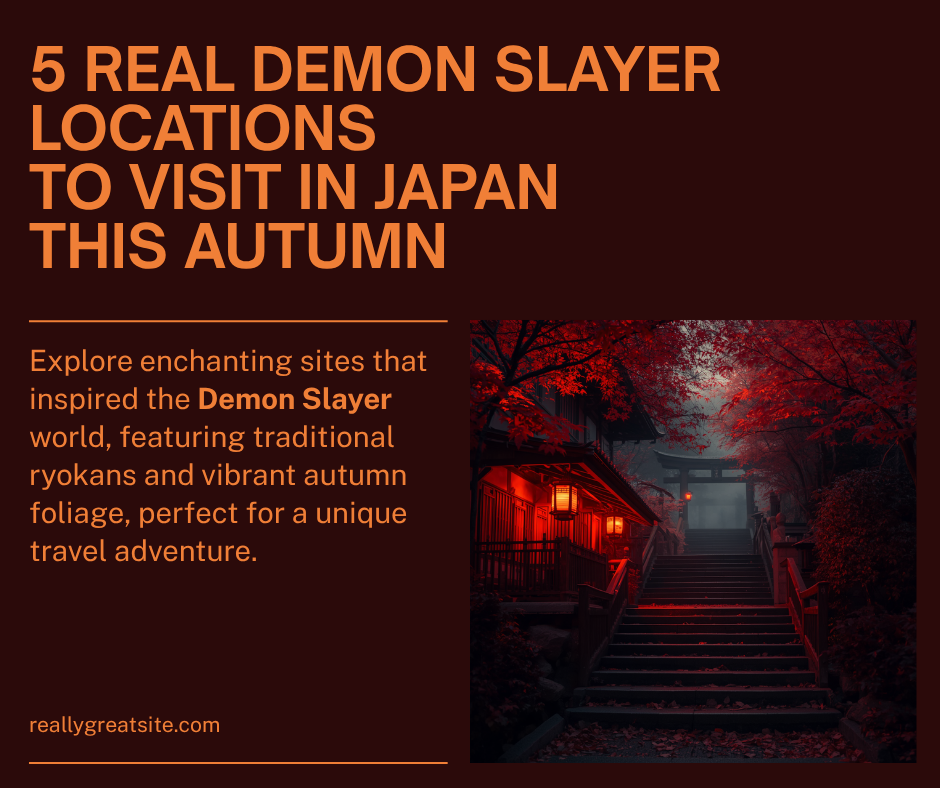
The answer is yes — more than you’d expect. As it turns out, some of the most striking visuals in Kimetsu no Yaiba weren’t purely drawn from imagination. They’re echoes of real places scattered across Japan, half-remembered by an artist who grew up here, sketched into a world of demons and swordsmen. And autumn happens to be the single best season to see them. The same crimson maple leaves that frame Tanjiro’s journey through the mountains are, right now, turning that exact shade of red across the country — the timing genuinely couldn’t be better.
This isn’t a list of “spots that sort of look similar if you squint.” Each of these five places has a real, documented connection to the series — some confirmed by location scouts, some by uncanny coincidence, some by nothing more than a shared name that happens to mean everything to the people who’ve made the pilgrimage. From a ryokan lobby that looks like it was lifted straight out of the Infinity Castle, to a quiet mountain shrine that shares Tanjiro’s own surname, to a boulder in the Nara hills that fans hike an hour just to stand next to — this guide brings together the most striking Demon Slayer real life locations Japan has to offer, timed perfectly for a Japan autumn trip.
Whether you’re planning your first trip to Japan, building out a dedicated anime pilgrimage itinerary, or just looking for an excuse to see the country’s autumn colors through a slightly different lens, here’s where to go.
Quick Summary
| Spot | Prefecture | Demon Slayer Connection | Best For |
|---|---|---|---|
| Ashinomaki Onsen Ookawaso | Fukushima | Infinity Castle vibes | Immersive overnight stay |
| Kamado Shrine | Fukuoka | Origin of the “Kamado” name | Shrine visit + autumn leaves |
| Ittoseki Rock | Nara | Tanjiro’s boulder-slicing training | Hiking + photo spot |
| Ashikaga Flower Park | Tochigi | Final Selection atmosphere | Night illumination |
| Kyoto Railway Museum | Kyoto | Mugen Train vibes | Steam locomotive experience |
One thing worth knowing upfront: these five spots are scattered across five different regions of Japan, from Tohoku down to Kyushu. This isn’t a “see it all in one weekend” itinerary — a rail pass or pre-booked transport can save you a surprising amount of time and money once you start mapping out the distances between them.
If you’re covering multiple regions, check [Japan Rail Pass options here] before you map out your route.
1. Ashinomaki Onsen Ookawaso (Fukushima) — The Real-Life Infinity Castle
If there’s one spot on this list that feels almost too on-the-nose, it’s this one.
Ashinomaki Onsen Ookawaso is a working hot spring ryokan tucked into the mountains of Aizuwakamatsu, Fukushima — the kind of long-established, slightly old-fashioned inn that’s existed quietly for decades, largely unbothered by tourism. That changed the moment a photo of its lobby started circulating online. Because the moment you step inside, you understand immediately why fans lost their minds over it.
The lobby is built around a striking red “floating stage,” raised above a still indoor pond and connected by winding staircases that spiral through several open floors of the atrium. It’s disorienting in the best way — walkways crossing at odd angles, staircases that seem to lead nowhere and everywhere at once. It’s an almost eerie match for the labyrinth-like Infinity Castle, the shifting fortress where Muzan Kibutsuji makes his final stand. And the resemblance doesn’t stop at the architecture: every day, a live shamisen performance takes place right on that stage, the sound resonating up through the atrium — an echo of the biwa-playing demon who controls the castle’s ever-changing rooms and corridors in the anime.
Staying here isn’t just a photo op. It’s an overnight, full-sensory version of the pilgrimage — you check in during daylight, watch the lobby transform as the shamisen performance begins in the late afternoon, then retreat to an open-air bath overlooking the Okawa River valley as evening falls. Few Demon Slayer locations let you actually live inside the reference this completely.
Access: From Tokyo, it’s roughly a 2.5–3 hour trip by shinkansen and local train to Ashinomaki-Onsen Station, followed by a short 5-minute shuttle bus (reservation required) or taxi ride to the ryokan itself. It’s not a difficult journey, but it does take some planning — this isn’t a spot you stumble into on a whim.
Autumn tip: Fukushima’s mountain scenery peaks in color from mid-to-late October through early November, wrapping the valley around the ryokan in deep reds and golds — arguably the best time of year to stay here. Try to check in early, around 3:30–4:00 PM, since the live shamisen performance typically takes place between 4:00 PM and 6:00 PM (the exact schedule can shift slightly depending on the season, so don’t cut it too close). Arriving early also means you get to watch the lobby fill with early-evening light before the performance starts — worth the extra buffer.
Since Ookawaso’s Infinity Castle lobby has become such a sought-after booking, rooms can fill up fast during peak autumn weekends. If you’d rather secure your spot in the same hot spring area with a bit more flexibility, Marumine Honkan is another well-regarded ryokan in Ashinomaki Onsen worth checking availability for.
2. Kamado Shrine (Fukuoka) — Where Tanjiro’s Name Came From
Tucked at the base of Mt. Homan near Dazaifu, Kamado Shrine (Homangu Kamado Jinja) has quietly become known among fans as the “Holy Land of Kimetsu” — and unlike some pilgrimage sites where the connection is purely visual, this one runs deeper than a resemblance.
The shrine’s name is written with the exact same characters as Tanjiro and Nezuko’s surname. Its Shugendo practitioners — mountain ascetics who train on these slopes — wear a checkered pattern strikingly similar to the one on Tanjiro’s signature haori jacket. And the shrine itself was historically built to guard against evil spirits entering from the “kimon,” the demon gate direction — a role that overlaps almost uncomfortably well with a series about a boy who hunts demons. Add in the fact that series creator Koyoharu Gotouge is originally from Fukuoka Prefecture, and the pieces start to feel less like coincidence and more like quiet inspiration.
But even setting the anime connection aside entirely, this is simply a beautiful, peaceful shrine to visit. It sits on a forested mountainside, the path up lined with trees that blaze orange and red in autumn, and an observation deck near the top offers a sweeping view out over Dazaifu below — the kind of quiet, elevated stillness that feels worlds away from central Fukuoka, even though you’re barely half an hour from the city.
Access: About a 10-minute community bus ride (“Mahoroba-go”) or taxi from Dazaifu Station — figure on roughly 15–20 minutes door-to-door once you account for waiting time — which itself is around 30 minutes from central Fukuoka by train. The shrine grounds themselves are open 24 hours, though the shop selling charms and ema plaques closes around 6PM, so plan your visit accordingly if you want a souvenir.
Autumn tip: The shrine is genuinely renowned for its fall foliage, with the surrounding hillside turning deep red and gold from around mid-November onward — locals come here specifically for this, not just anime fans. If your visit lines up with the shrine’s autumn illumination period, an evening visit adds a completely different, more atmospheric mood to the experience. And since it’s so close to the famous Dazaifu Tenmangu Shrine, most visitors sensibly combine both stops into a single unhurried half-day trip.
3. Ittoseki Rock (Nara) — Tanjiro’s Boulder-Slicing Training Ground
For fans who remember Tanjiro’s grueling training under Sakonji Urokodaki — specifically the seemingly impossible task of slicing a boulder clean in half — Ittoseki Rock is about as close to that scene as real life gets.
This massive split boulder sits deep along a hiking trail in the forested hills outside Nara, far enough off the beaten path that you won’t find tour buses or souvenir stands here. Just trees, dirt trail, and eventually, this enormous rock cleaved cleanly down the middle, as if some impossibly strong swordsman really had taken a blade to it centuries ago. Standing next to it, you get why it’s become such a beloved photo stop for fans willing to make the trip — the scale of it is genuinely striking in person, more so than any photo really captures.
Unlike some of the more polished, staged locations on this list, this one asks something of you. It’s reached via a genuine hiking trail through forested terrain, which honestly only adds to the payoff — this isn’t a spot you casually wander into between shopping stops. It’s a small pilgrimage in the literal sense, and that effort is part of what makes reaching it feel earned.
Access: From JR Nara Station or Kintetsu Nara Station, take a bus (around 50 minutes) to the Yagyu bus stop, then hike roughly 15–20 minutes along a mountain trail to reach the rock itself.
Autumn tip: There are no vending machines or restrooms along the trail, so bring your own water and wear proper walking shoes — this is genuine hiking terrain, not a paved sightseeing path, and it’s easy to underestimate that if you’re coming straight from a day of temple-hopping in sandals. The trail sits shaded and pleasantly cool even in early autumn, making October one of the more comfortable months to make the hike before the winter chill sets in properly. Try to go on a clear day if you can — the trail can get genuinely slippery after rain, and there’s nothing worse than a twisted ankle an hour into the forest.
4. Ashikaga Flower Park (Tochigi) — Final Selection Atmosphere
Ashikaga Flower Park is best known internationally for one thing: its cascading, almost impossibly photogenic wisteria in spring. But visit in autumn instead, after dark, and you’ll find a completely different park waiting for you — one that happens to line up remarkably well with a very different part of the Demon Slayer story.
Once the sun sets, the gardens transform into a sprawling, layered illumination display — countless lights woven through the trees and pathways, mist effects drifting low across the ground, colors shifting slowly from deep blues to warm golds as you walk. It creates the same kind of dreamlike, faintly unsettling beauty that fans associate with Mt. Fujikasane, the eerie mountain setting of the Final Selection arc, where young demon slayer candidates are forced to survive a single night surrounded by demons in the dark.
You won’t find actual wisteria glowing purple here in autumn — that’s a spring-only spectacle — but the illuminated pathways, the drifting mist, and the way the light shifts as you move deeper into the gardens create a genuinely cinematic mood, especially if you time your visit right at dusk to catch the transition from daylight into the full lit-up display.
Access: About a 3-minute walk from Ashikaga Flower Park Station on the JR Ryomo Line, which sits directly next to the park entrance — genuinely one of the easiest-to-reach spots on this entire list.
Autumn tip: The autumn illumination event, known as the “Flower Garden of Light,” typically runs from mid-October through mid-February, with the park staying open until around 8:30PM during the season. Arrive right before sunset so you catch that transition moment — the park in fading daylight, then gradually, all at once, lit up in full.
5. Kyoto Railway Museum — Mugen Train Vibes
No list connected to Demon Slayer would feel complete without a nod to the Mugen Train arc — arguably the single most iconic arc in the entire series, and the one that turned the franchise into a genuine cultural phenomenon in Japan.
The Kyoto Railway Museum delivers exactly the atmosphere you’re looking for. Inside, you’ll find a working collection of retro steam locomotives from the Taisho and early Showa eras — the same historical period the Mugen Train arc draws its entire aesthetic from, right down to the rivets and the soot-stained metal. You can walk right up to these engines, and even ride the museum’s own “SL Steam” train for a short scenic loop inside the museum grounds (a small additional ticket, around 300 yen, is required — well worth it for the full experience).
Walking through the museum’s roundhouse, surrounded by hissing steam, glowing embers, and century-old rail cars lined up in a slow, deliberate arc, is about as close as you’ll get in real life to standing on the platform before boarding your own Infinity Train — minus the demons, hopefully.
Access: A short, easy walk from Kyoto Station, making this one of the simplest additions to slot into any Kyoto sightseeing day.
Autumn tip: Kyoto in autumn draws genuinely overwhelming crowds for its temples and shrines, so the Railway Museum makes an excellent lower-key half-day activity to break up a temple-heavy itinerary. It’s also fully indoors, which makes it a reliable backup plan if a rainy autumn day threatens to derail your outdoor sightseeing.
Book skip-the-line tickets to the Kyoto Railway Museum here to make the most of your visit without waiting in line.
Travel Tips for Demon Slayer Fans Visiting in Autumn
Dress in layers. Japan’s autumn mornings and evenings can be genuinely cold, especially in mountain areas like Fukushima and Nara, even while afternoons still feel comfortably mild. A packable jacket you can shed and stuff into a bag makes a bigger difference than people expect.
Book ryokan stays early. Ashinomaki Onsen Ookawaso has become a genuinely popular destination since its Demon Slayer connection went viral online, and autumn weekends — peak foliage season — fill up fast. Booking 1–2 months ahead is a safe bet, and don’t forget to reserve the shuttle bus in advance if you’re not planning to take a taxi from the station.
Pace yourself geographically. These five spots span Fukushima, Fukuoka, Nara, Tochigi, and Kyoto — this genuinely isn’t a one-trip itinerary. You’ll get far more out of it by folding these into a broader regional trip (Kansai for Nara and Kyoto, Kyushu for Fukuoka, Tohoku for Fukushima) rather than trying to force all five into a single exhausting loop.
Check foliage forecasts before finalizing dates. Japan’s autumn colors move gradually from north to south, so Fukushima typically peaks earlier (mid-to-late October) than Kyoto or Fukuoka (mid-to-late November). A quick foliage forecast search a few weeks before your trip will help you time each stop for maximum color.
Conclusion
What makes these spots special isn’t just the anime connection — it’s that every single one of them is a genuinely worthwhile destination in its own right, autumn colors or not. A ryokan with a jaw-dropping atrium and nightly live music, a shrine with over a thousand years of history, a hiking trail with a dramatic, hard-earned payoff, a garden built entirely around evening light, and a museum full of living, breathing rail history — Demon Slayer fandom just gives you one more reason to seek each of them out.
If you’re building your Japan travel guide 2026 around these Kimetsu no Yaiba pilgrimage spots, the smartest approach is to pick the region that naturally fits your route, rather than trying to chase all five in one trip. Whichever one you choose, you’ll be visiting Japan during the exact season that makes these places look their absolute best — and walking away with a version of the country most Demon Slayer fans only ever see on a screen.
If your route leans heavily toward the Kansai side of this list — Nara’s Ittoseki Rock and the Kyoto Railway Museum — a regional pass like the JR West Kansai Rail Pass can make getting between those two spots considerably more affordable than buying individual tickets.

コメント