- Introduction
- Quick Summary
- Stop 1 — The Meguro River: Tokyo’s Most Atmospheric Urban Canal
- Stop 2 — The Back Alleys: Where Tokyo-3 Lives Off-Screen
- Stop 3 — Afuri Nakameguro: The Yuzu Shio Bowl You Can’t Replicate Elsewhere
- Stop 4 — EN Tea Ceremony (Nakameguro Area): The Afternoon That Grounds the Day
- Travel Tips
- Conclusion
- Sources
Introduction
There’s a neighbourhood in southwest Tokyo that two very different audiences have claimed as their own — and almost no one has noticed the overlap.
For lifestyle travellers and Japanese media, Nakameguro needs no introduction. It’s the city’s most photogenic canal district: low-rise, leafy, threaded by the Meguro River and its famous curtain of cherry trees. Japanese fashion magazines have shot it for decades. International Instagram grids fill up with its reflections every spring.
For anime fans, especially those devoted to Neon Genesis Evangelion, Nakameguro carries a different kind of weight. Hideaki Anno — the series’ director, creator, and the man whose personal struggle with depression became the show’s emotional skeleton — lived and worked in this part of Tokyo during the years he conceived and produced Eva. The show’s oppressive, low-key urban atmosphere, its cramped apartment corridors, the particular quality of afternoon light falling on concrete in Tokyo-3: these are not invented from nothing. They are the aesthetic of a specific neighbourhood, absorbed by a specific person walking the same back streets you can walk today.
This article is a concrete, half-day pilgrimage that holds both of those audiences at once. It starts at Nakameguro Station and moves through four distinct stops: a slow walk along the Meguro River (stop 1), a wander through the low-rise back alleys that carry the neighbourhood’s real Eva atmosphere (stop 2), a bowl of yuzu shio ramen at Afuri — the cult local shop that sits steps from the canal (stop 3) — and finally a bookable matcha tea ceremony to close the afternoon on something reflective and grounding (stop 4).
You don’t have to love Eva to do this trip. But if you do love it, this is the closest you can get to standing inside the show’s emotional world without a time machine.
Quick Summary
| Stop | What it is | Time needed | Cost | Book ahead? |
|---|---|---|---|---|
| Meguro River walk | Scenic riverside walk; Eva atmosphere | 45–60 min | Free | No |
| Nakameguro back alleys | Self-guided neighbourhood wander | 30–40 min | Free | No |
| Afuri Nakameguro | Yuzu shio ramen | 30–45 min | ~¥1,000–¥1,500 | No (walk-in) |
| EN Tea Ceremony (or nearby alternative) | Hands-on matcha session | 45–60 min | ~¥3,500–¥6,000 | Yes — book in advance |
Getting there: Nakameguro Station is served by the Tokyu Toyoko Line and the Tokyo Metro Hibiya Line. From Shibuya: 2 minutes by Tokyu Toyoko. From Roppongi: about 15 minutes via Hibiya Line. No JR connection — plan your IC card accordingly.
Best overall timing: A Tuesday–Thursday start at 10:00 AM avoids both the weekend rush and the post-lunch ramen queue. During cherry blossom season (late March to early April), arrive by 8:00 AM if you want the river to yourself.
Stop 1 — The Meguro River: Tokyo’s Most Atmospheric Urban Canal
Why this spot is worth visiting
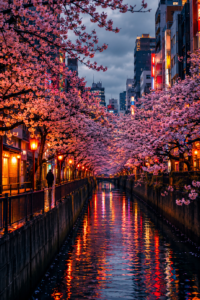
Most English-language guides treat the Meguro River as a pleasant canal walk. That framing sells it short in every direction. For one, it’s one of the most genuinely beautiful pieces of urban landscape in all of Tokyo: approximately 800 cherry trees line a 4-kilometre stretch of the river, their branches trained to arch toward each other over the water, creating a tunnel effect that explains why Japanese lifestyle media hasn’t stopped photographing this place for thirty years.
But there’s an Eva dimension too. The canal’s combination of compressed urban scale — the buildings close in on both sides, the sky appears only in a narrow strip above the water — and its quiet, slightly melancholy mood in non-cherry-blossom months maps almost perfectly onto the residential streets of Tokyo-3. Anno wasn’t drawing a fantastical future city from scratch. He was drawing the kind of city a thoughtful, anxious young person actually lives in, and Nakameguro’s canal district is exactly that kind of city. Walk the river on an overcast November afternoon and you’ll understand what we mean immediately.
Access
Exit Nakameguro Station via the East Exit. The river is visible within sixty seconds of leaving the ticket gates — you’ll hear it before you see it. Turn left (north) toward Daikanyama for the quieter upstream section, or right (south) toward Meguro for the livelier stretch lined with cafés and boutiques. The full navigable promenade runs roughly 4 kilometres; a comfortable Eva-paced stroll of the most atmospheric section — from the station north to Ikejiri-Ohashi and back — takes about 45 minutes.
Best time to visit
For cherry blossoms, the peak is late March to early April, when all 800 trees bloom simultaneously. During the festival, paper lantern illuminations run nightly from around 17:00 to 20:00, creating a pink-tunnel effect on the water that genuinely has to be seen to be believed.
The bad news: everyone knows. Weekend afternoons during peak bloom are shoulder-to-shoulder. The smart move is a weekday visit, or arriving before 9:00 AM on any day. For a crowd-lighter approach, start from Ikejiri-Ohashi Station (one stop north on the Tokyu Toyoko Line from Nakameguro) and walk south — this upstream stretch is significantly less congested than the area immediately around Nakameguro Station.
Outside sakura season, the river is open and uncrowded year-round, and it has its own charm in every season: deep summer green, autumn rust, the stark bare geometry of winter branches over grey water. For the Eva mood specifically, a grey-sky autumn or winter morning is actually more evocative than cherry blossom peak.
Note: picnic blankets are prohibited along the Meguro River. Enjoy the walk standing or with a takeaway coffee from one of the riverside cafés.
Practical notes
Entry is completely free. No booking, no tickets, no dress code. The riverside path is wheelchair-accessible along its main stretches. The nearest toilets are in Nakameguro Station and at Goryuten Park, a short walk from the station. Bring cash for the food stalls during festival season — most are card-free.
Combining with other stops
The river walk is your natural opening move. It deposits you back at Nakameguro Station with your bearings established, ready to step off the main tourist circuit into the back alleys for Stop 2.
Stop 2 — The Back Alleys: Where Tokyo-3 Lives Off-Screen
Why this spot is worth visiting
This is the stop that no other English-language Nakameguro guide includes, because it has no Instagram hook and no landmark name. It’s simply the neighbourhood itself — the dense, low-rise residential grid west of the river, between the station and Daikanyama — experienced as a deliberate, slow wander.
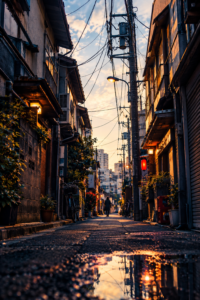
Anno made Eva during the 1990s while living in this part of Tokyo. The show’s quietest, most personal sequences — Shinji walking to school, Misato’s cramped apartment, the particular way afternoon light falls through slatted blinds onto a kitchen counter — carry the texture of a specific real neighbourhood. That neighbourhood is here. The buildings are two and three storeys, the streets are barely wide enough for a car, telephone wires cross overhead at every intersection, and small local businesses — a laundry, a hardware shop, a tofu seller — survive in the gaps between the cafés and concept stores.
You are not going to find a memorial plaque or an official pilgrimage route. What you will find is something rarer: the source material. Walk slowly. Look up at the overhead wires against the sky. Notice how the buildings press the street into a corridor. You don’t need to verify any of this against a specific scene — the atmosphere IS the reference.
Access
From the Meguro River, cross at any of the small bridges west of Nakameguro Station and head into the grid. The most evocative streets run roughly parallel to the river, one and two blocks back from the waterfront: Kamimeguro 2-chome and 3-chome are a good starting anchor. There’s no prescribed route — getting a little lost is the point. A 30–40 minute wander brings you naturally back toward the station or toward Daikanyama.
Best time to visit
Any time outside of cherry blossom festival weekends. This area absorbs visitors invisibly during off-peak times. A weekday late morning — after the commuters have left and before the lunch crowd thickens — gives you the neighbourhood almost to yourself.
Avoid Sunday afternoons from 12:00–17:00 during spring and autumn, when the boutiques draw a significant browsing crowd and the character shifts from quiet neighbourhood to street-market.
Practical notes
This is pure self-guided exploration — no tickets, no admission, no booking. Wear comfortable walking shoes; the back streets have uneven paving. Mobile signal is good throughout; carry Google Maps but resist the urge to optimise your route. A physical notebook for sketching or writing impressions will serve you better here than a curated photography grid. Respect the residential character: keep voices low, don’t photograph inside private shopfronts without asking.
For Eva fans specifically: you are not looking for a scene recreation. You are looking for the atmosphere that made the scene possible. That’s a subtler, slower, and ultimately more satisfying form of pilgrimage.
Combining with other stops
This wander deposits you in roughly the same area as Afuri — either via the main commercial street running parallel to the river, or by looping back to the station. Time your wander to arrive at Afuri between 11:00 and 11:30 to beat the lunch queue.
Stop 3 — Afuri Nakameguro: The Yuzu Shio Bowl You Can’t Replicate Elsewhere
Why this stop is worth visiting
Ramen shops are not hard to find in Tokyo. A ramen shop that has spent twenty years refusing to change its founding vision — light, clean, chicken-based broth infused with yuzu citrus, no tonkotsu trend-chasing, no MSG reliance — is considerably rarer. Afuri opened its first Tokyo location in Ebisu in 2003 and built its reputation on exactly that refusal. Named after Mount Afuri (known locally as Oyama) in Kanagawa Prefecture, the brand draws on the fresh spring water from that mountain as both literal ingredient and philosophical anchor. The Nakameguro location sits a few steps from the Meguro River, making it the natural lunch anchor for this itinerary.
The specific bowl to order is the yuzu shio ramen. Shio means salt; this is the lightest base in the ramen spectrum, and in Afuri’s version it carries a golden chicken broth built on whole chickens, chicken neck, ginger, kelp, and niboshi (dried sardines), with a citrus finish from real yuzu. Thin whole-grain noodles sit underneath charcoal-grilled chashu pork, half a soft-boiled ajitama egg, mizuna greens, bamboo shoots, and a curl of shredded yuzu peel. The bowl is aromatic and clean rather than heavy, built for a day when you still have a tea ceremony ahead and don’t want to feel sluggish.
If you’re a fan of bolder flavour, the yuzu ratan ramen (spicy yuzu) is the counter-intuitive escalation. For warm-weather visits, the cold spicy yuzu tsukemen (dipping noodles) is worth serious consideration — the yuzu’s fragrance intensifies significantly when the broth is served cold.
Afuri also offers a vegan ramen option, making this one of the more reliably inclusive ramen shops in Tokyo for plant-based visitors.
Access
Afuri Nakameguro is inside the Nakameguro Arena building, 1-23-1 Kamimeguro, Meguro City — on the ground floor of the building directly across from the station. From the East Exit of Nakameguro Station, it’s about 90 seconds on foot. You cannot miss it.
Best time to visit
Afuri Nakameguro is open from 11:00 AM daily. Weekday openings between 11:00 and 11:45 AM see the shortest waits. By 12:30–13:30, a queue typically forms. The Nakameguro location is open late — current hours run until 11:30 PM on most days, and until 5:00 AM on Friday nights — making it viable as a post-tea-ceremony dinner if you want to revisit.
Avoid Saturday and Sunday lunchtimes during cherry blossom season (late March to early April), when the surrounding area is overwhelmed with visitors and queue times stretch significantly.
Practical notes
Ordering: The Nakameguro branch uses a touchscreen ordering machine at the entrance — select your bowl, customise (standard or maro/chicken-fat-enriched broth; standard or temomi noodles), add toppings, and pay. The machine has English-language support. No reservations needed or accepted for walk-in ramen service.
Price: A standard yuzu shio ramen bowl runs approximately ¥1,000–¥1,500 depending on toppings. With all toppings added, budget up to ¥1,500. Afuri accepts credit cards (Visa, Mastercard, JCB, Amex), IC transportation cards (Suica etc.), and QR payment apps — this is one of the most payment-flexible ramen shops in Tokyo.
Seating: Counter-only, solo-dining-friendly layout. Turnover is quick even during peak hours. If there’s a queue outside, join it — it moves faster than it looks.
Dietary: Vegan ramen is available. Pork can be swapped for chicken in most bowls at no extra cost. No MSG in the broth.
Combining with other stops
After lunch, you have two natural directions. If your tea ceremony is booked for the early afternoon (14:00–15:00), head directly — most Nakameguro-area tea experiences are within a short taxi or 10-minute walk. If you have time before your slot, this is the moment to Nakameguro neighbourhood walking tour, picking up a coffee from one of the riverside cafés before crossing into the back alleys again or heading to Daikanyama’s covered shopping arcade, Nakameguro Koukashita (the atmospheric space built under the elevated railway tracks).
Stop 4 — EN Tea Ceremony (Nakameguro Area): The Afternoon That Grounds the Day
Why this stop is worth visiting
There’s a dissonance at the heart of an Eva pilgrimage that no piece of merchandise can resolve: the show is ultimately about the difficulty of being present in your own experience, of receiving the world without retreating from it. A matcha tea ceremony — specifically the hands-on, instructor-led kind where you whisk your own bowl rather than being served — is, structurally, the exact antidote to that problem. It forces presence. It has no screen, no queue, no next-episode button. There is one bowl, one motion, one moment of bitter and sweet arriving together.
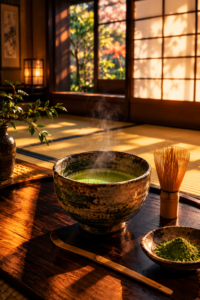
The Nakameguro and Daikanyama area has a small but growing cluster of intimate, bookable tea experiences that serve the international visitor well. EN tea ceremony (and equivalent small-format experiences available through GetYourGuide and Klook near Daikanyama/Nakameguro) offer 45–60-minute hands-on sessions led in English, typically in a traditional tatami tea room setting, with full whisking instruction and a seasonal wagashi sweet pairing.
What actually happens in a session (approximate schedule):
- T+0:00 — Arrive, remove shoes, enter tatami room. Instructor introduces themselves and gives a brief overview of the tea ceremony’s origins and the philosophy of ichi-go ichi-e (one time, one meeting — the idea that each encounter is unique and unrepeatable).
- T+5:00 — Observation round: the instructor performs a full bowl of matcha from start to finish, narrating each motion — the folded fukusa cloth, the warming of the chawan bowl, the measured scoop of matcha powder, the specific wrist motion of the chasen (bamboo whisk).
- T+20:00 — Your turn. You receive your own chawan, your own chasen, and your own measured portion of matcha. The instructor guides you through each step. The whisking technique — a brisk W-motion, not a circular stir — takes most people two or three attempts to get right. This is intentional; the point is not perfection.
- T+35:00 — Drinking round. Your bowl is served alongside a seasonal wagashi sweet (typically a soft nama-gashi, its shape tied to the current season — a leaf, a flower, a snow motif). You eat the sweet first, then drink the matcha in three and a half sips according to tradition.
- T+45:00 — Q&A and quiet time. You’re encouraged to ask anything — about the utensils, the school of tea, the sourcing of the matcha. Most sessions end with the option to photograph your bowl and the room.
This is not a performance you watch. It is something you do. That distinction matters enormously in 2026, when passive cultural tourism is everywhere and participatory culture is the thing visitors are actually hungry for.
Access
EN tea ceremony and comparable Nakameguro-area sessions are located within the Daikanyama and Nakameguro neighbourhood, typically a 5–10 minute walk from Nakameguro Station or a 3-minute walk from Daikanyama Station on the Tokyu Toyoko Line. Confirm the exact meeting point when you book — some sessions begin at the teacher’s studio, which may not be listed on Google Maps.
Alternatively, To-Ri-An, an Urasenke-school tea ceremony space located in Meguro Ward (walkable or a short taxi from Nakameguro), offers a highly regarded private and small-group experience with bilingual teachers who have taught internationally.
Best time to visit
Afternoon slots — typically 13:30 to 16:00 — work best as the anchor close to this itinerary. Morning sessions exist but are better suited to travellers doing the tea ceremony as their primary activity rather than the final beat of a half-day walk.
Book at least 3–7 days in advance, and further ahead during cherry blossom season (March–April) and major holiday weekends, when small-format cultural experiences fill up rapidly. Tokyo is currently receiving record visitor numbers, and instructor-led tea sessions simply cannot add seats the way a restaurant can.
Practical notes
Booking: Nakameguro tea ceremony booking through GetYourGuide, Klook, or byFood — search “Nakameguro tea ceremony” or “Daikanyama matcha experience.” Confirm English instruction is included before booking. Most platforms allow cancellation up to 24 hours before the session with a full refund.
Price: Expect ¥3,500–¥6,000 per person for a solid 45–60 minute hands-on session with instruction. Private bookings typically carry a premium over group sessions.
What to bring/wear: Wear socks (white socks are ideal for tatami tea rooms). Remove all bulky jewellery that could scratch lacquerware. Avoid strong perfume — it interferes with the subtle fragrance of the matcha and the incense that some rooms use. Do not arrive barefoot.
First-timer mistakes: Do not drink the matcha before eating the wagashi sweet — the sweetness of the confection is designed to prepare your palate. Do not stir the matcha in circles; use the W-motion the instructor demonstrates. Do not worry about perfection — every instructor who leads these sessions for international visitors has seen a hundred variations of beginner form and will guide you through it without judgment.
Combining with other stops
After your tea ceremony, you’re naturally positioned for one final wander before catching the train home. Daikanyama T-SITE (the architecturally celebrated bookshop complex a 5-minute walk from Daikanyama Station) is the perfect low-key close to the day — browse the architecture and art sections, buy something beautiful, and let the afternoon wind down at its own pace. Alternatively, head back to the Meguro River for the lantern illuminations if it’s cherry blossom season — the transition from the quiet of the tea room to the pink glow of the river is one of those Tokyo moments that rewards being unhurried.
Travel Tips
Getting an IC card: All transport in this itinerary runs on IC card. Load a Suica IC card before you arrive or top up at any station. Afuri also accepts IC payment at the ordering machine.
Timing the full itinerary: Arrive at Nakameguro Station by 10:00 AM. River walk: 10:00–11:00. Back alley wander: 11:00–11:45. Afuri lunch: 11:45–12:30. Free time/Koukashita browsing: 12:30–13:30. Tea ceremony: 13:30–14:30. Daikanyama wind-down: 14:30–16:00. This gives you a six-hour half-day with breathing room.
Cherry blossom season specifics: The lantern illuminations during cherry blossom festival run 17:00–20:00. If you’re visiting in late March or early April, consider extending your day: Afuri stays open late, so a ramen dinner at 19:00 bookends a lantern walk beautifully.
Travelling solo: Every stop on this itinerary is solo-friendly. Afuri’s counter seating is particularly well-suited to solo diners, and most tea ceremony operators accommodate solo bookings (though some charge a two-person minimum — check before booking).
Carrying cash: While Afuri and most modern shops accept cards, some of the smaller boutiques in the back alleys and the food stalls during cherry blossom season are cash-only. Carry ¥3,000–¥5,000 in notes.
Language: The Afuri ordering machine has English. Most tea ceremony operators who cater to international visitors conduct sessions in English. The back alley wander requires no Japanese at all. This is a reliably foreigner-navigable itinerary.
Eva essentials to rewatch before you go: Episodes 1–3 (for the Tokyo-3 urban atmosphere), Episode 16 (the interior monologue sequence, which captures the show’s relationship to confinement and self), and The End of Evangelion (for the question of what presence in the world actually looks like). None of these require Nakameguro-specific knowledge — but they will deepen what you notice when you’re walking the back streets.
Conclusion
Most pilgrimages — anime or otherwise — ask you to stand in a location and feel something by proximity. This one is different. Nakameguro doesn’t have a shrine to Anno or a plaque outside a building. What it has is the atmosphere that made a specific work of art possible: the compressed scale, the canal’s watery quiet, the back streets that turn ordinary urban life into something slightly unsettling and achingly familiar. You walk through the source material rather than toward a memorial.
Add a bowl of yuzu shio ramen whose broth has been refined for twenty years without compromise, and a tea ceremony that forces you to be present in the precise way that Shinji Ikari spends twenty-six episodes trying and failing to be, and you have something that earns the word pilgrimage in the fullest sense.
Come back in a different season. The river is different every time.
Sources
- Timeout Tokyo — Afuri Nakameguro listing: Opening hours (Mon–Thurs, Sat, Sun 11am–11:30pm; Fri 11am–5am), address, and menu overview verified. https://www.timeout.com/tokyo/restaurants/afuri-nakameguro
- Trip.com — Afuri Nakameguro branch: Address (1F Nakameguro Arena, 1-23-1 Kamimeguro), opening hours cross-reference, and price range (¥1,000–¥1,500/bowl) verified. https://sa.trip.com/moments/detail/tokyo-294-143785847
- 5AM Ramen — Afuri review: Broth composition (whole chickens, chicken neck, ginger, kelp, niboshi), menu philosophy, and pricing upper range (up to ¥1,300 with toppings) verified. https://www.5amramen.com/post/afuri-ramen-tokyo
- Japan Travel (en.japantravel.com) — Yuzu Ramen at Afuri: Bowl composition detail (noodles, chashu, ajitama, mizuna, bamboo, nori, yuzu peel) and menu options verified. https://en.japantravel.com/tokyo/yuzu-ramen-at-afuri/20469
- AutoReserve — Afuri Nakameguro: Payment methods confirmed (credit cards Visa/MC/JCB/Amex/Diners, IC cards, QR codes). https://autoreserve.com/en/restaurants/uiD6fZu1zaYSPoRe14NJ
- MATCHA Japan Travel Guide — Meguro River Cherry Blossoms 2026: Peak season (late March–early April), crowd avoidance advice (weekdays/early morning), illumination hours (17:00–20:00 in 2025), picnic blanket prohibition, and access from Naka-Meguro Station (1 min from East Exit) verified. https://matcha-jp.com/en/23476
- Tokyo Night View Guide — Nakameguro Cherry Blossom Festival: Illumination schedule details (sunset–8:00 PM), 800 cherry trees along 4km stretch, and lantern atmosphere confirmed. https://nightscape.tokyo/en/event/meguro-river/
- byfood.com — Nakameguro cherry blossom festival: Best time to visit, Ikejiri-Ohashi upstream start-point tip for crowd avoidance confirmed. https://www.byfood.com/blog/news/nakameguro-cherry-blossom-festival-returns
- E-Housing Tokyo Tea Ceremony Guide 2026: Typical hands-on tea session price range (¥3,500–¥6,000 per person), advance booking requirements, socks/no perfume etiquette confirmed. https://e-housing.jp/post/tokyo-tea-ceremony-guide-2026-where-to-experience-traditional-japanese-tea
- Wabunka / To-Ri-An: Urasenke-school tea ceremony in Meguro Ward, bilingual teachers, private/group options confirmed. https://wabunka-lux.jp/experiences/en_torian-2/
- BFI — Neon Genesis Evangelion feature: Series context, Anno as director, Eva’s relationship to personal psychological experience, and show’s urban atmosphere as character confirmed. https://www.bfi.org.uk/features/neon-genesis-evangelion
- Evangelion Wiki (Fandom) — Hideaki Anno: Production history, Anno’s role as creator and writer of nearly every episode, studio Gainax founding confirmed. https://evangelion.fandom.com/wiki/Hideaki_Anno


コメント